
We need to take the opportunities other companies are missing.
Cal Archer (Team Member, Designer)
OVERVIEW
THE TEAM
TEAM SIZE
Five Members
DURATION
Five Weeks
METHODS
Literature Review, How Might We, Empathy Exercise, Competitor Research, Sketching, Prototyping, User Testing

PURSUING GROUP ORDER
OPPORTUNITIES FOR THE
DOMINO’S APP
VISION STATEMENT
Within the growing landscape of food-delivery services and the expanding opportunities for new and unique food ordering solutions, the need to innovate products that cater to the evolving needs of the user is becoming increasingly relevant. As such, our app aims to position the Domino’s Corporation and its online ordering application against other food delivery services, by catering to the unique need of a group ordering process, providing a collaborative method of creating orders and developing methods of in-app split payments. Developing this service will allow Domino’s to reach a wider audience through its increasing accessibility and will provide a solution to a problem that has not been addressed by a majority of food delivery services, effectively positioning the company against the new tide of delivery competition.
In a study conducted by AlphaWise in April of 2016 of more than 5,000 participant, it was found that nearly two-thirds had placed take-out orders in the prior nine months, demonstrating a significant opportunity developing in the food service industry to cater the need of food delivery options. Since then, many businesses have taken this opportunity, utilizing secondary services such as GrubHub and DoorDash in order to reach wider audiences. This has created greater competition for pizza delivery services such as Domino’s which had previously been the main source of delivery options for fast food customers, but one weakness is shared by a majority of food delivery services: group ordering. This app will cater to this rarely explored opportunity, separating the Domino’s ordering app from other food delivery services and solidifying its position as an industry leader.
THE CHALLENGE
The challengie in creating a group ordering app lies mainly in the ability to create a product that caters to the complex needs of the user, while also maintaining the intuitive simplicity of the ordering process. While their exists an opportunity for Domino’s to differentiate itself from other pizza delivery services via pursuing the avenue of a group ordering feature, it is also important to understand and capitalize on the strengths of the current apps design and functionality, and as such, it becomes a challenge to both innovate new solutions that help to differentiate the company while not straying from the aspects of the ordering process from which the company has already profited. The main challenge of this Sprint will be to generate functional solutions that do not deter users that have become accustomed to the current order process.
Additionally, the team is tasked with positioning this app within an expanding landscape of food delivery services, some of which already cater to the group ordering issue. As such, the challenge becomes not only how to create a group ordering experience, but how to differentiate this specific process and product from other like it that already exist. Doing so will have to surpass the current stigmas already surrounding the brand regarding the quality of the company’s product, while also including features that heighten the convenience of the ordering process and integrate the ordering process into key features of the user’s life so as to promote its business and increase its accessibility.
THE SPRINT
DAY 1 | UNDERSTAND
The first day of the sprint found our team focused mainly on understanding the problem at hand by means of understanding the industry to which Domino’s belonged as well as the history of the business itself, defining the problems which our design solution would be solving, and building empathy for the users which this app would serve, aiming to achieve an understanding of their concerns and experiences in order to create a solution that would result in the most effective group ordering experience. In order to achieve this, the team conducted a series of different activities to accomplish these goals which included a preliminary literature review and analysis, an activity that served to define the problem, and a final exercise in empathy.
Prior to the first day of the design sprint, each member of the team conducted individual research into the history of Domino’s and the company’s recent growth and innovations as a developing “tech company”. This stage of the team’s research involved reviewing previous articles written about the company’s efforts to differentiate and position itself against competitors such as Pizza Hut and Little Caesars by means of advancing itself on the technological front, creating innovative and unique ordering processes that allowed them to reach wider audiences and cater to its customers quickly, effectively and conveniently.
Additionally, we reviewed several studies regarding the current state of the food delivery industry in order to better understand the relevance of the challenge at hand and the expanding opportunities related to the industry. Utilizing the information obtained from this research, Bryan, Cal, and Jacob set out to create a SWOT analysis, which summarized the comparative standing of Domino’s as a Pizza Delivery Service against its competitors, discovering opportunities for the company in improving its social media presence, widening the scope of the companies appeal by promoting the quality of its product, and pursuing brand partnerships to widen the reach of the company and revitalize intrigue.
In our first group session following our initial individual research, our team set out to define the problems that were to be solved through our design, using a “How Might We” activity in order to define the scope of the project and the questions we needed to be pursuing. This process followed the team’s discussion of the initial literature review and the insight we had gained from it, focusing mainly on the areas of opportunity that could be pursued through our design solution. As such, this activity allowed the team to ideate and pursue unique and innovative avenues such as making use of locational services in order to encourage the ordering process and predict user ordering, creating partnerships with other businesses to create intriguing new promotions, and widening the company’s appeal to more health minded customers.
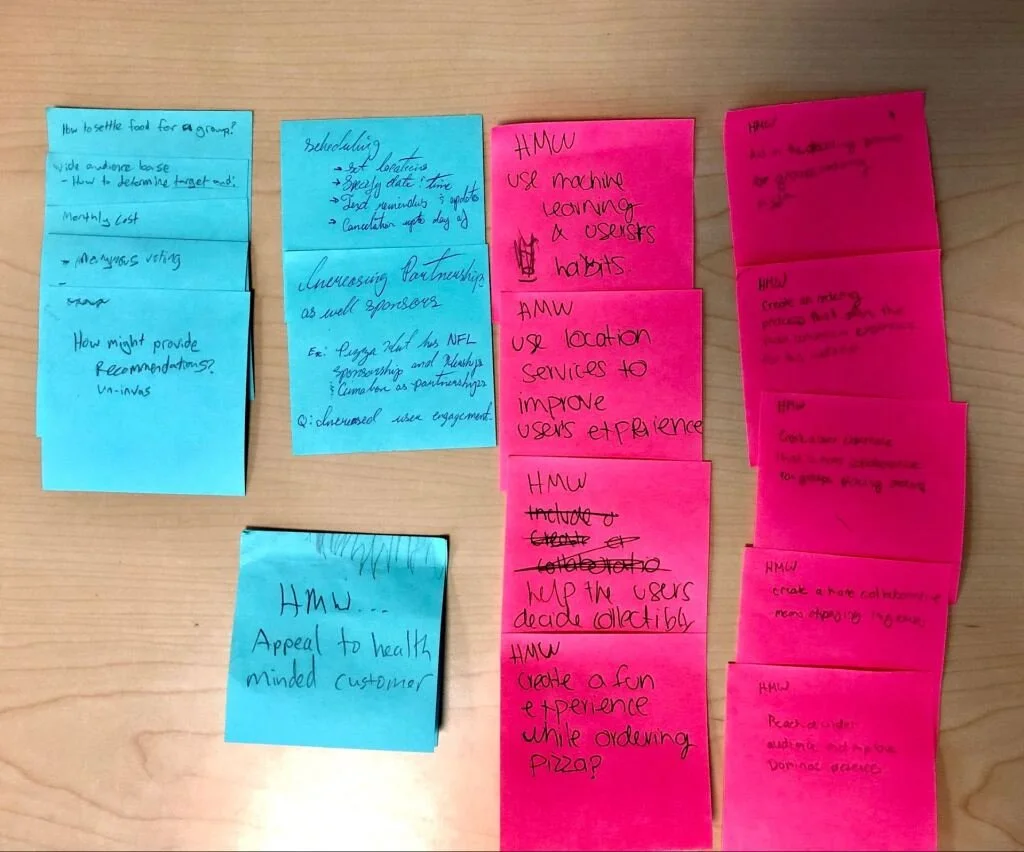
The Team’s collective HMW statements
Day One of our design sprint was rounded out by a final exercise in empathy, wherein the group conducted a user test using Domino’s current mobile ordering app. This process was carried out by Cal, Luis and Jacob, while the remaining members performed user tests for other groups. Through this exercise, the team was able to gain an understanding of how user currently interacted with the ordering experience, exposing the thought process of the user and their current frustrations with the design. The user test performed by the team demonstrated the lack of ability to account for large group orders and a tedious ordering process. The ability of the remaining group members to participate in performing user tests allowed for them to gain insight into the frustrations a user might have with the ordering process, allowing us to identify the problems to be addressed.
DAY 2 | SKETCH
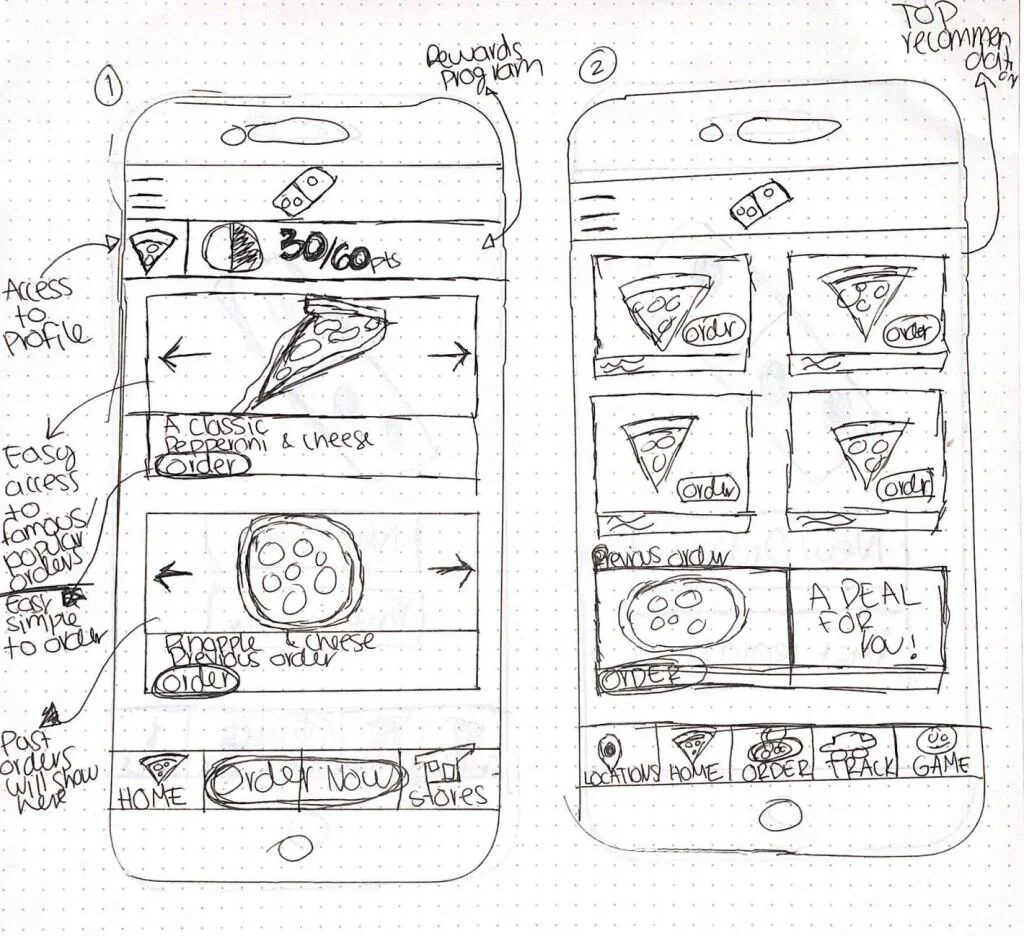
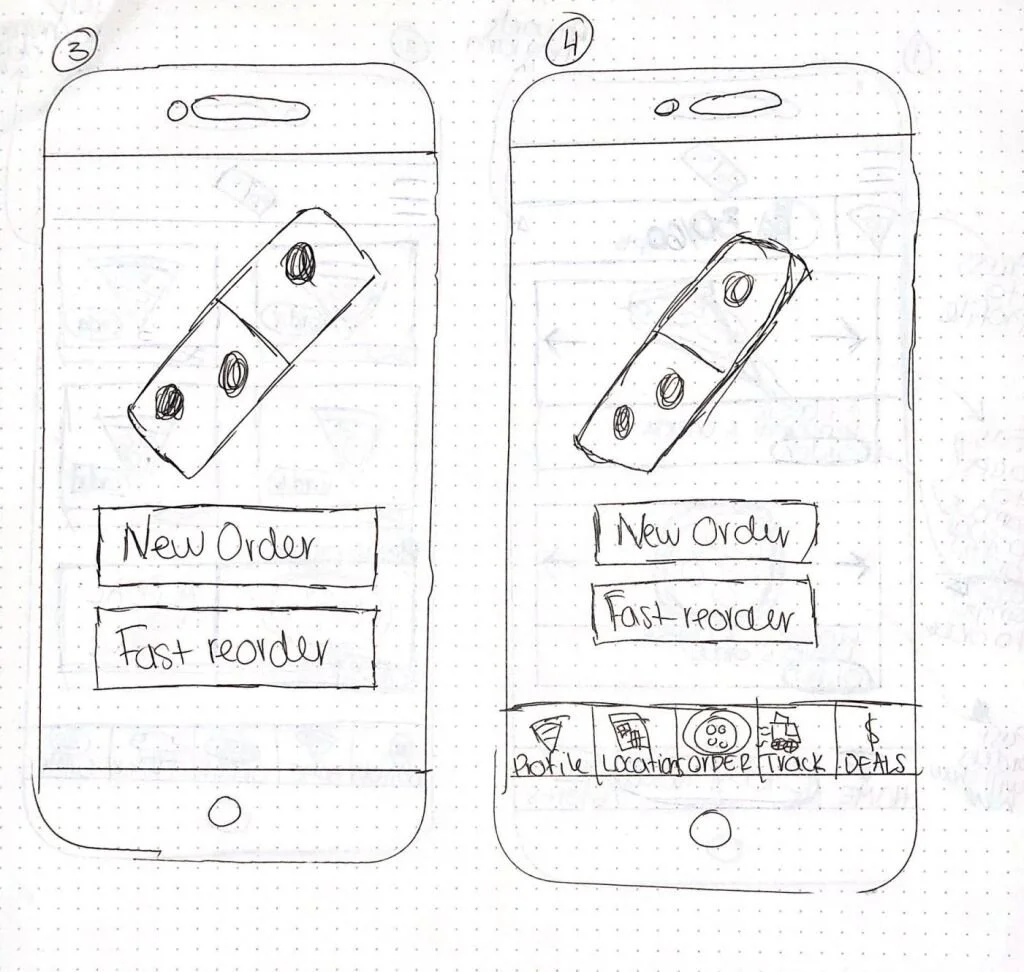
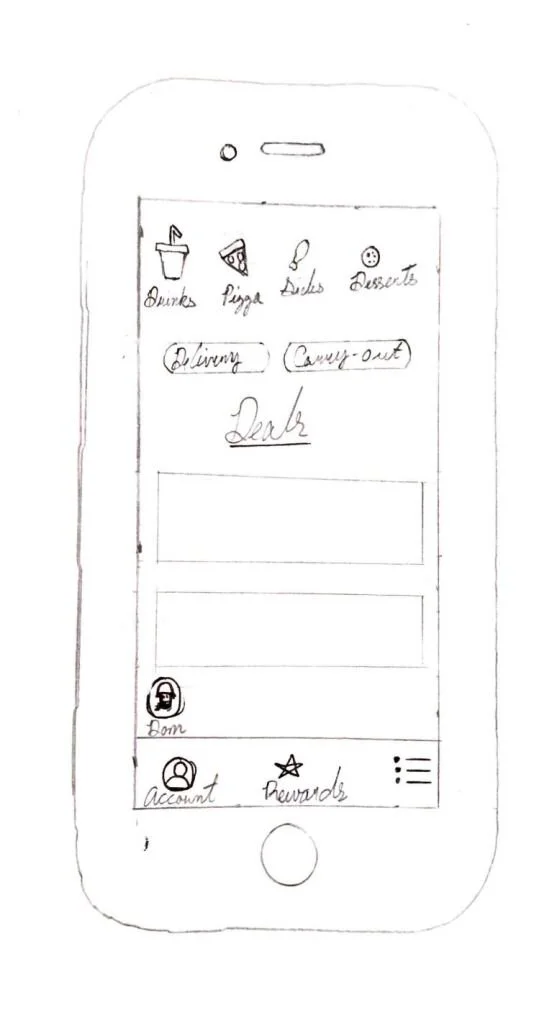
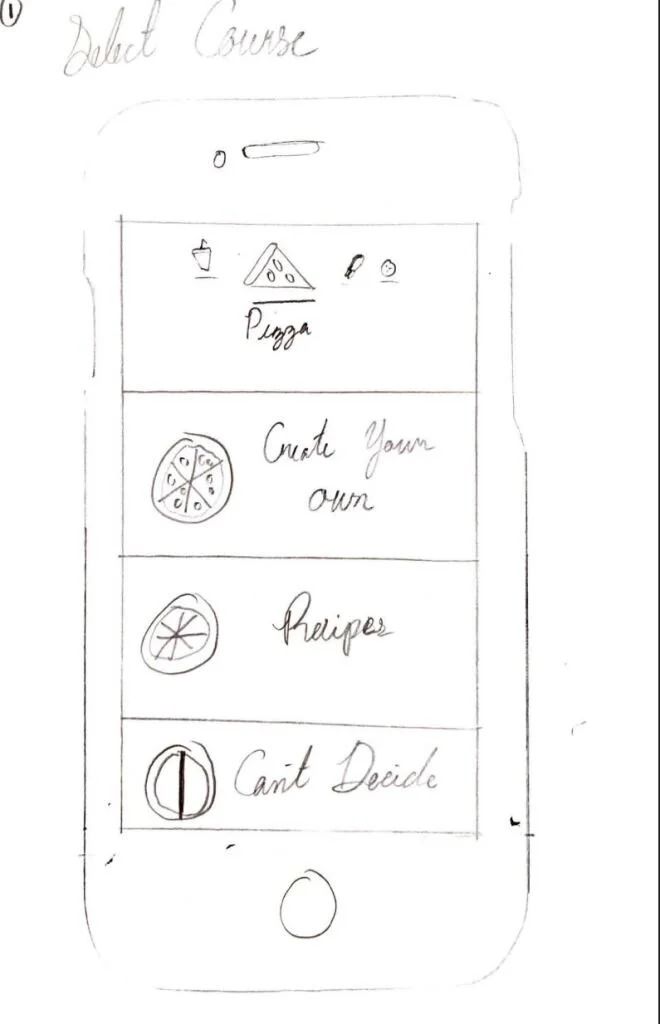
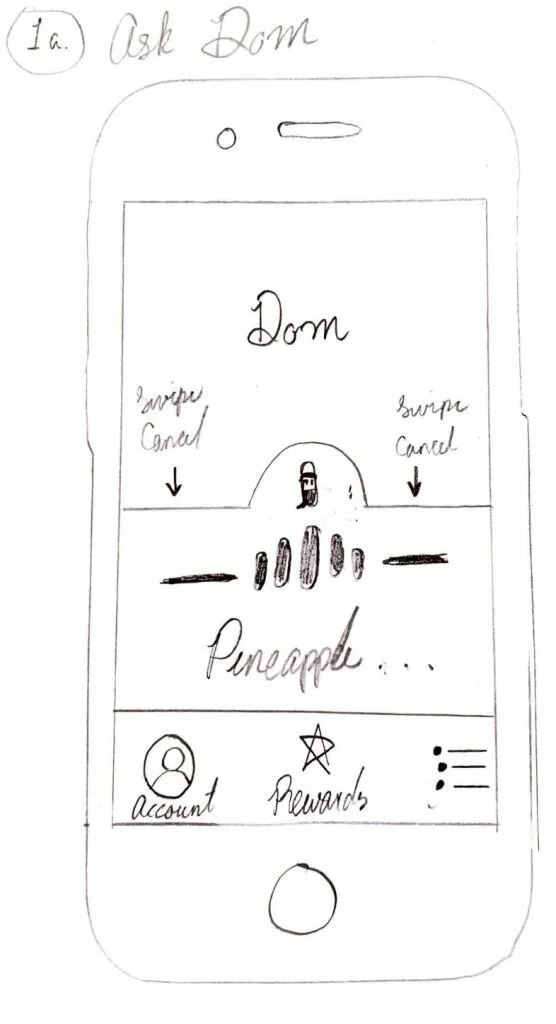
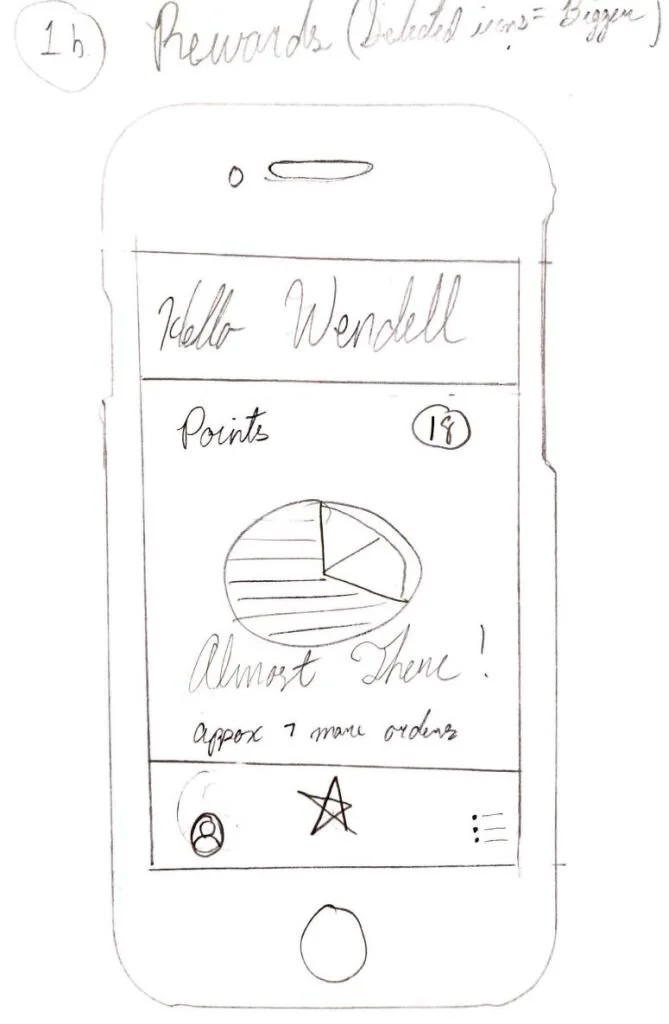
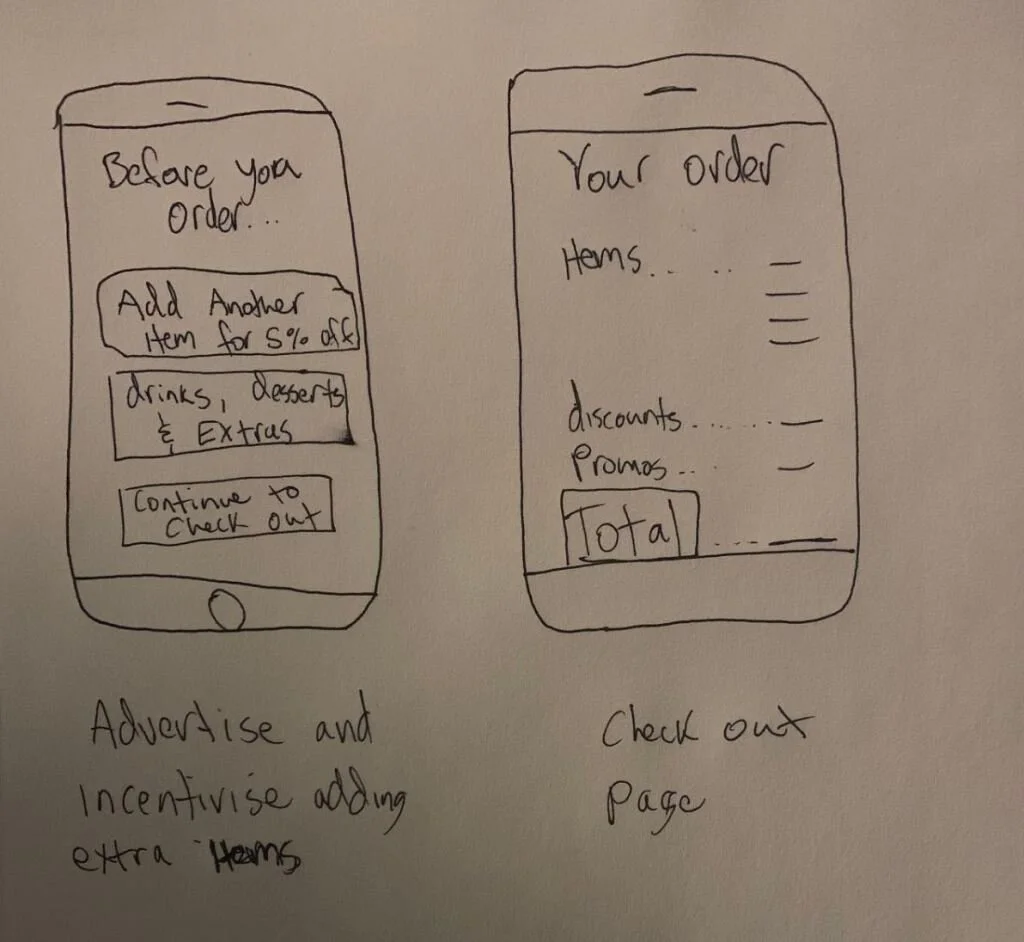
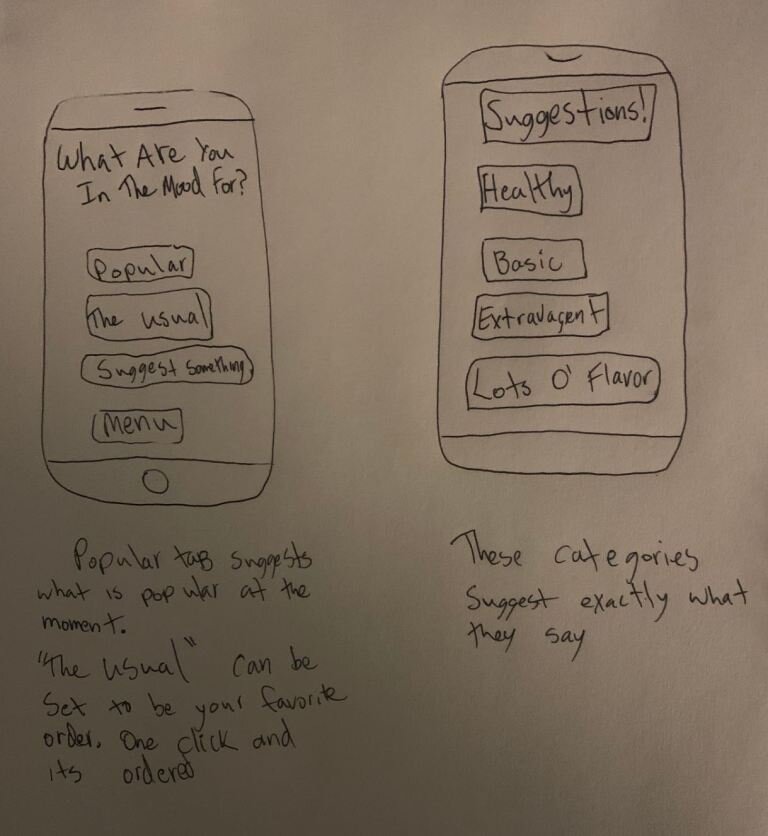
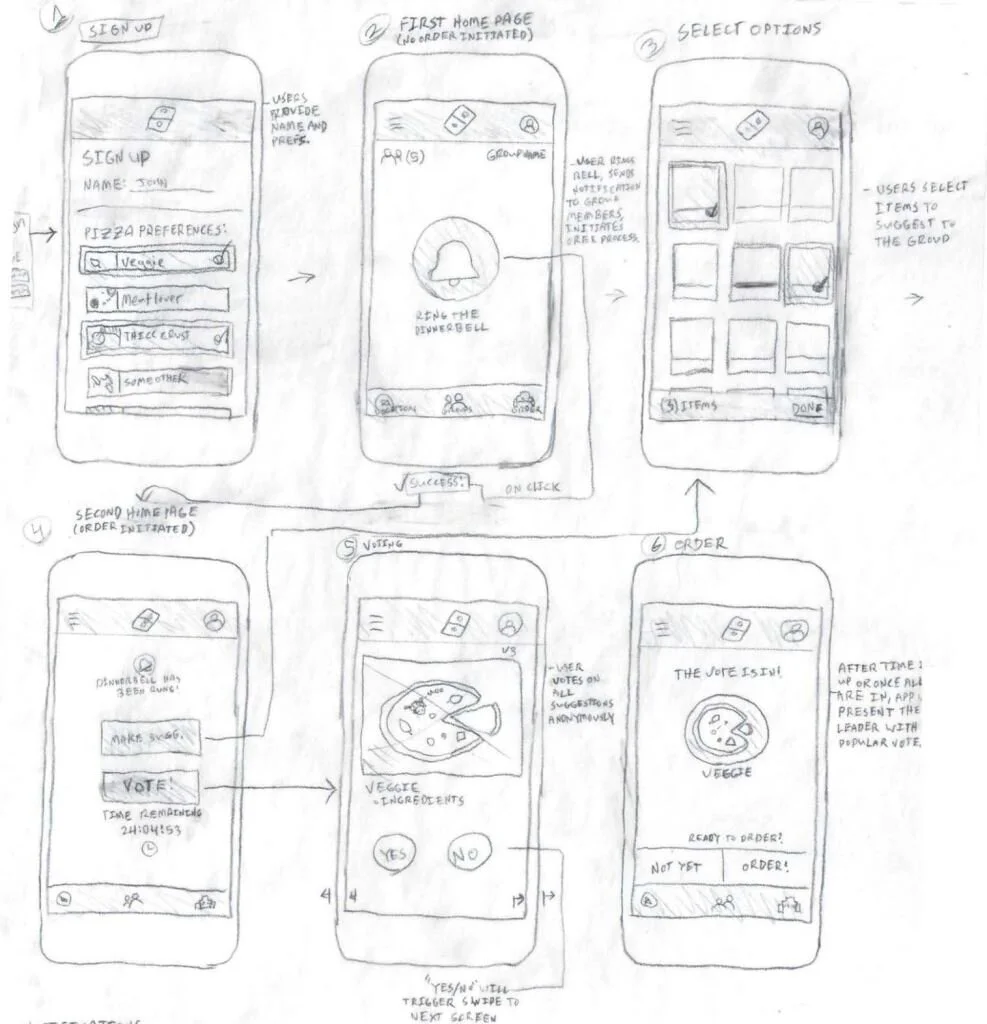
With the insight gained from the “Understanding” phase of our study, the team then set out to ideate possible solutions from the problems discovered in the first stage of our research, eventually creating initial sketches for the designs of our final app solution. Our first day concluded with our understanding of the problems that needed to be addressed by our solutions, and as such, set us in the direction of a collaborative ordering app that offered quick ordering options in order to fast track the ordering process. From the insight gained from our first day research, the team had aimed to create a unique ordering experience that utilized a game-like ordering process (inspired by Kahoot), in order to allow individuals to vote and collaborate.
The sketching and ideation process then began with additional research conducted by Luis and myself into related products that could be looked to for inspiration in our design solutions in order to pursue the directions we had defined on day one of the sprint. This research was conducted by reviewing three different apps or services that were not directly related to the Pizza delivery industry and was documented in research videos created by the team members.
This stage of our research intentionally avoided products and businesses that were in direct competition with Domino’s, mainly other pizza franchises such as Pizza Hut in order to create unique solutions that did not cater to current common trends. In avoiding these businesses, Luis and I were able to explore unconventional avenues that would typically be overlooked in the pizza ordering process.
Luis’s research focused on Amazon and Starbucks as possible inspiration for his design solution, exploring the predictive ordering ability of Amazon and its ability to fast-track the ordering process by storing information on previous purchases in order to create quick and convenient suggestion, as well as the ease of ordering remotely provided by the Starbucks app. Similarly, my research also focused on Amazon as a source of inspiration, but also attempted to find inspiration for the issue of split payments in group ordering, consulting Splitwise as my example, as well as reviewing Grub Hub’s group ordering process in order to understand how the process of group ordering had been addressed by other companies.
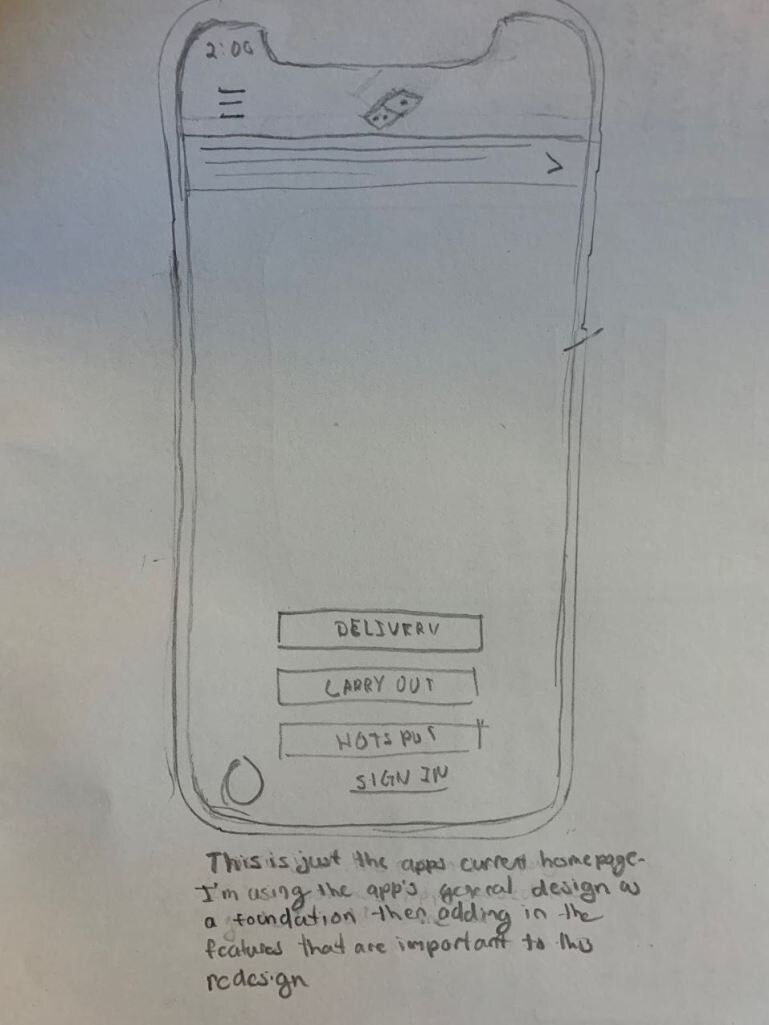
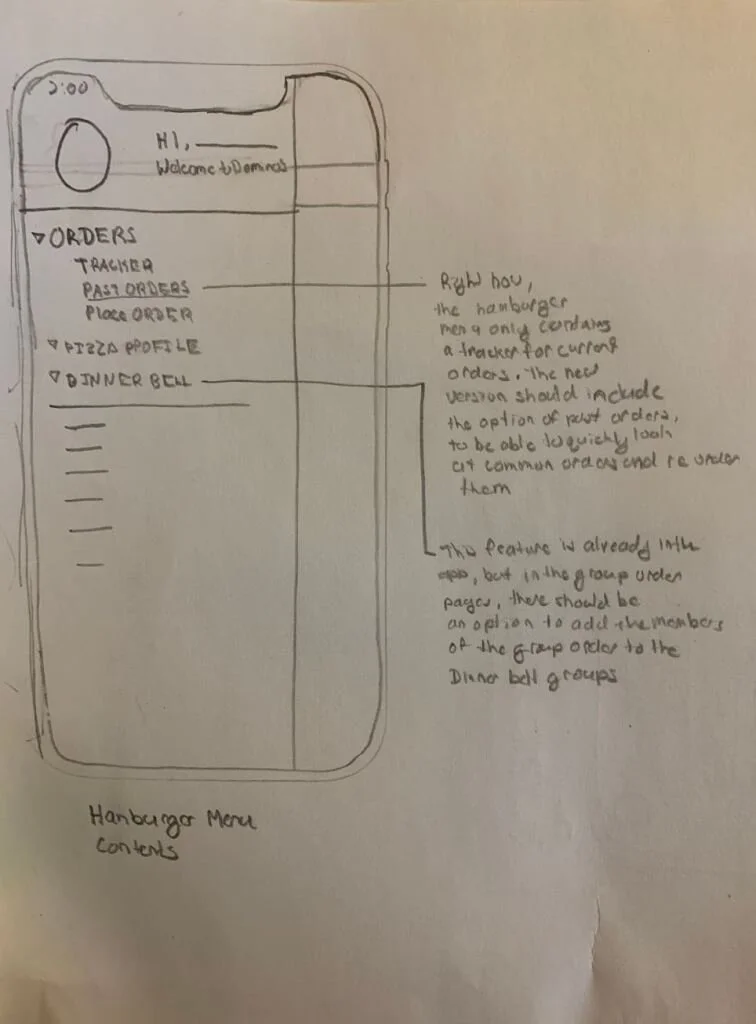
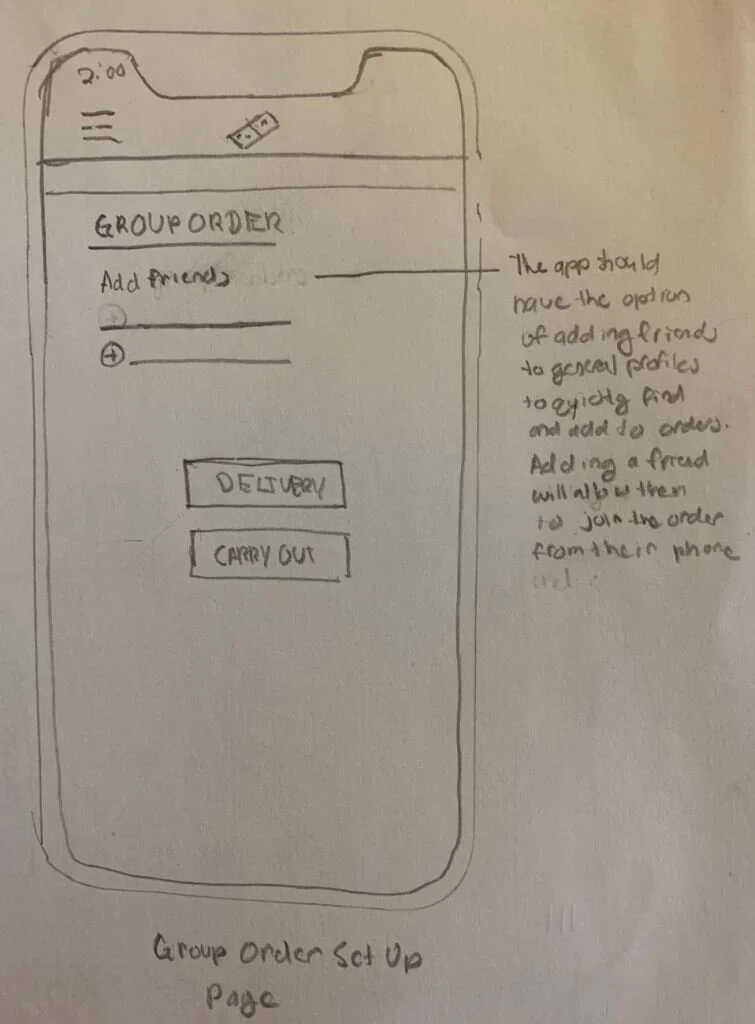
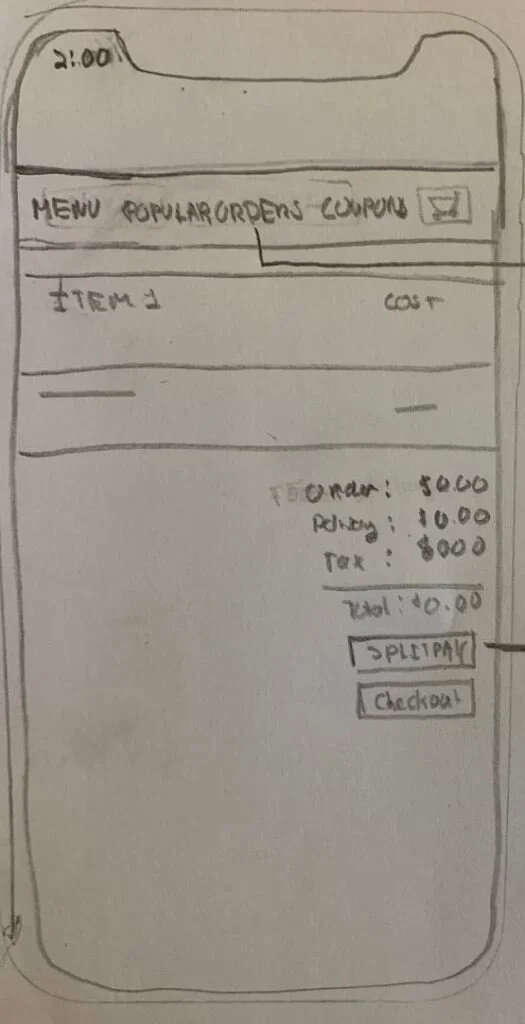
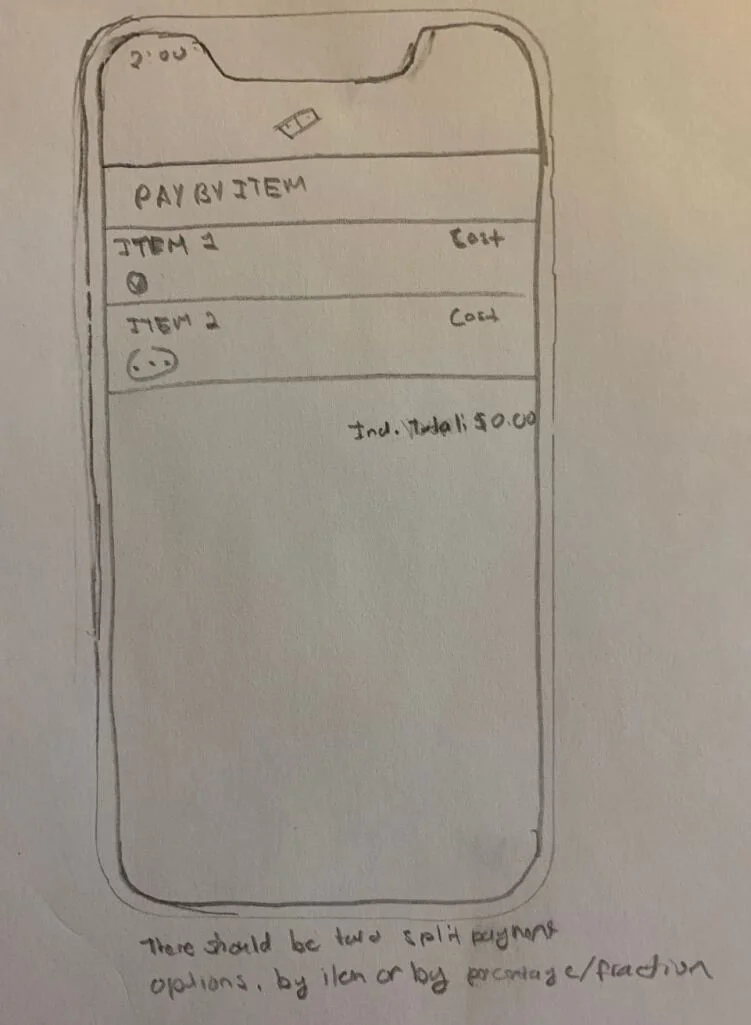
From the insight gained from creating these research videos, the team members then set out to devise their own sketches for possible design solutions, making use of the different features from the explored apps and finding ways to integrate these solutions into our own designs. My own designs focused mainly on the process of integrating Grub Hub’s group ordering process which involved the ability to create a group and invite group members to revise orders from their own phones, while also making use of the split payment feature provided by Splitwise so as to cut out middleman of having to outsource the payment process to other split payment services such as Venmo.
The process of creating initial sketches was conducted individually by each of the team members, as each one had been tasked with creating three different concept screens to be uploaded to the groups shared folder and which would be reviewed by each of the members remotely in order to compensate for our lack of ability to meet in person.
DAY 3 | DECIDE
After each of the team members had had time to individually ideate and create low fidelity sketches, the next step of the design process was to choose a design direction to pursue and expand upon, a task that was accomplished through a group voting session. Conducted during an in-class session, each of the team members brought in their own sketches which were then presented in a gallery to be reviewed and voted on. Each of the members galleries included each individual sketch laid out, accompanied by written explanations of the functionality of each screen and the design direction chosen.
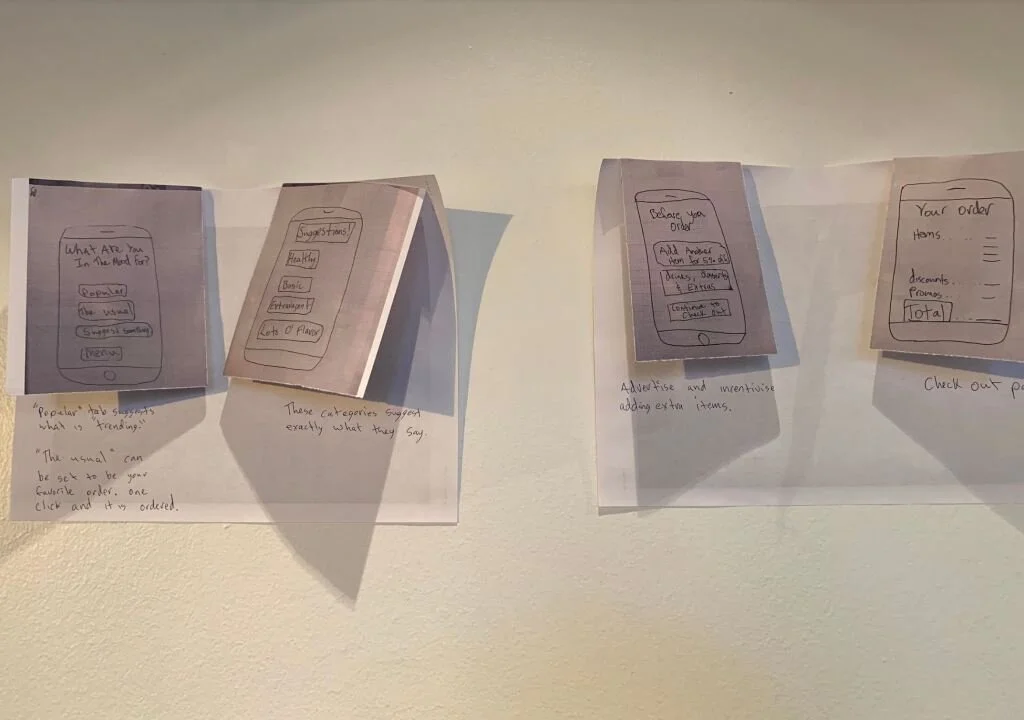
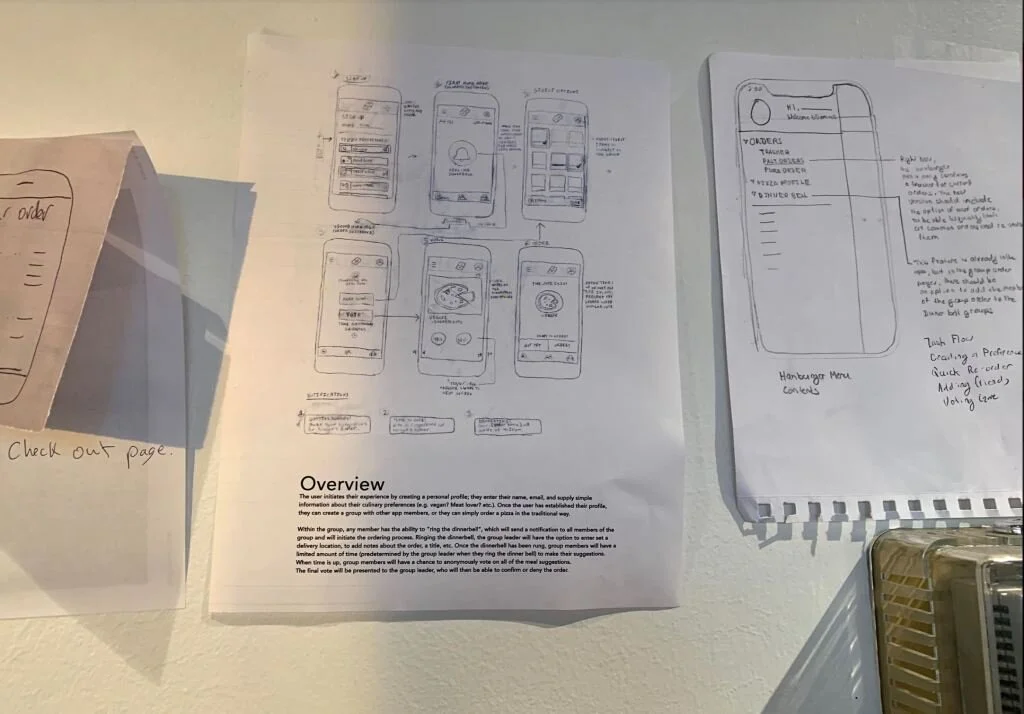
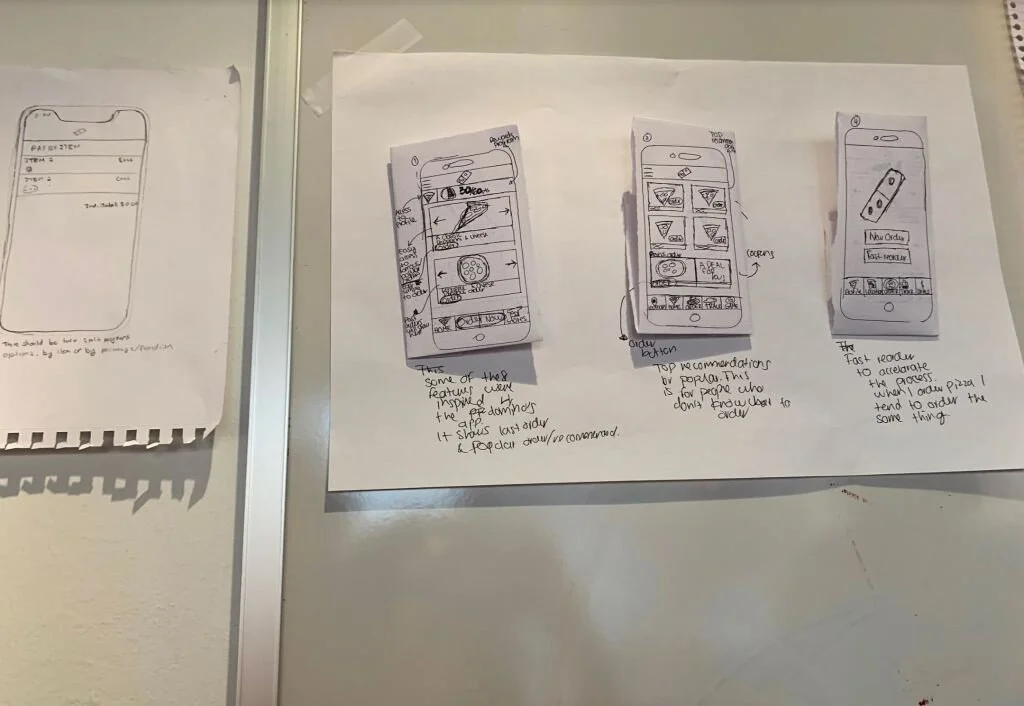
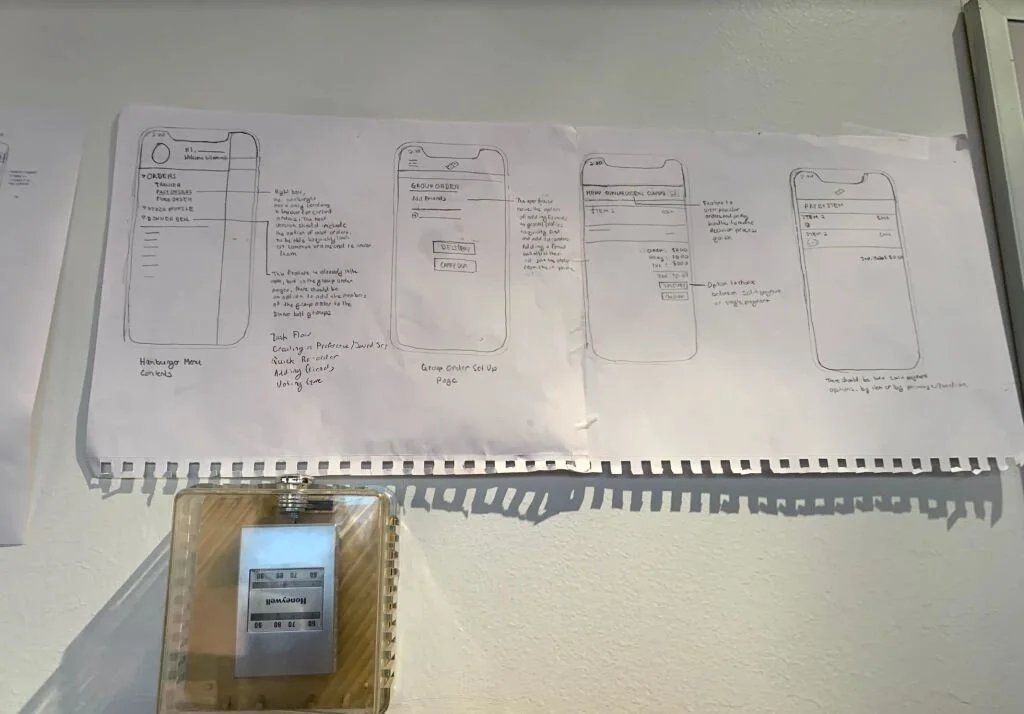
The Team’s sketch galleries
With each gallery posted on the walls, the team then reviewed each of the members work without any explanation from the designers. The choice to review the sketches silently allowed each of the members to examine the ideas with out context, processing the individual design without justification and allowing the team to determine the weaknesses and strengths of the designs at first glance. Without explanation or justification, the team was able to generate questions for the designers in order to guide the direction of the discussions.
After reviewing the sketches silently, each designer was then allowed the chance to explain their works and provide clarification for any of the design choices they had made. Jacob’s designs centered around the current features of the Domino’s ordering app, while making use of a more personalized ordering experience, and emphasizing the usage of Dom, the brand’s current AI tool, whereas Luis had taken to integrating the insight he had gained from the research videos, pursuing a predictive ordering direction that utilized the ability to store information of past orders and allow the user to quickly reorder a past order.
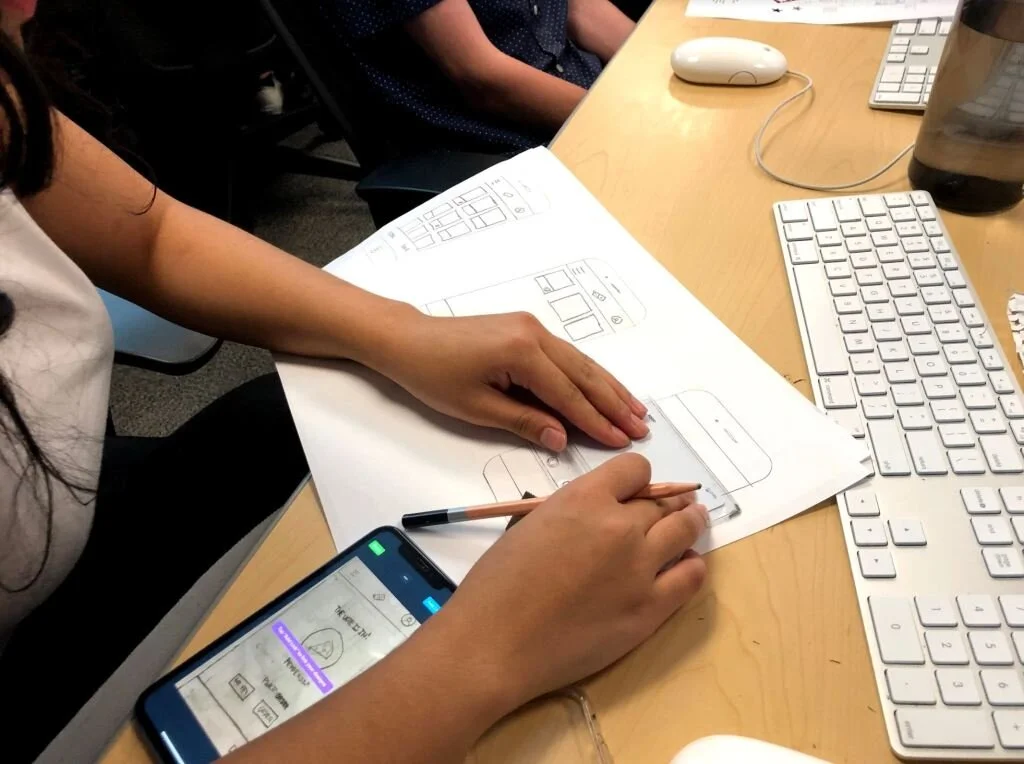
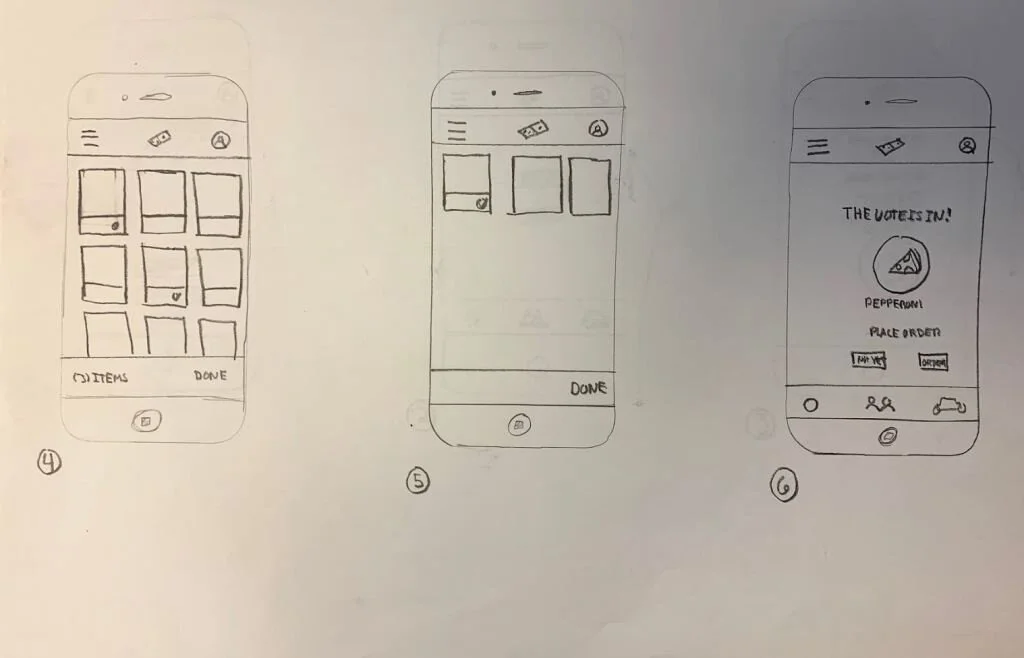
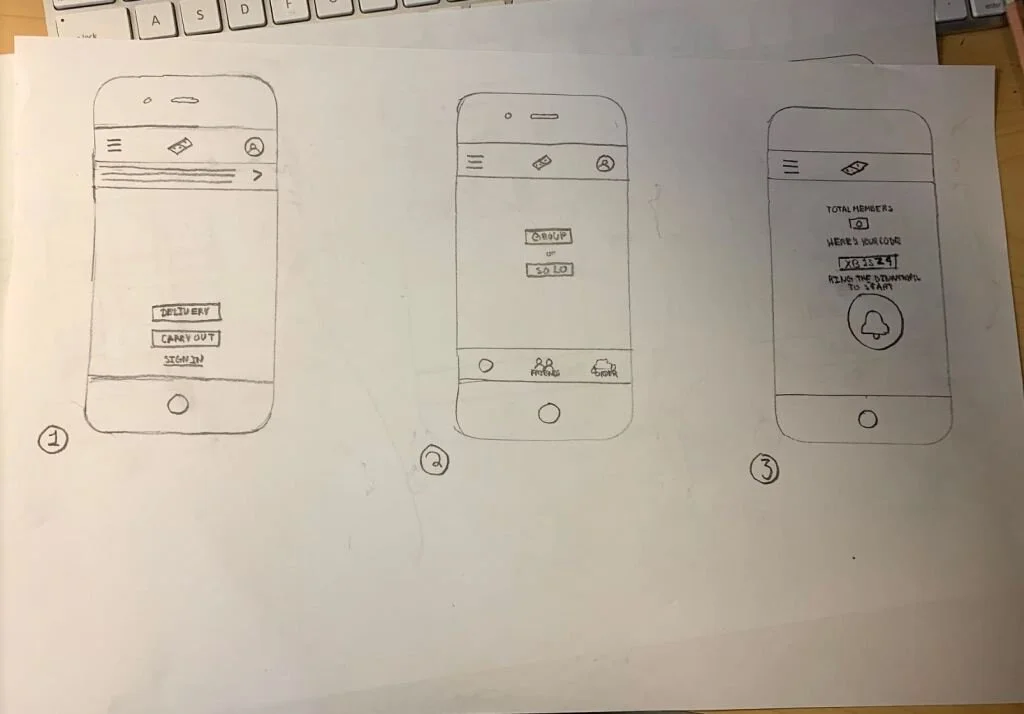
Ultimately, we came to the decision of merging the ideas presented by Bryan and Myself, as well as the predictive ordering from Luis’s sketches in order to create a game-oriented ordering process that allowed individuals to order collaboratively, quickly, and conveniently. In deciding this, the team had agreed on using Bryan’s overall design aesthetic and game ordering process combined with my split payment method and Luis’s quick reorder option, and we then set out to create quick concept screens to visualize the solutions we had voted on, which were then presented to the class in order to gain feedback and expose the possible holes in our solution.
Merging design directions
Merging our design directions
After drafting six screens that belonged to the task flow of creating a group order and that represented the desired design aesthetic and concept, I, the team leader, then presented the teams ideas to the class with a quick explanation of the ordering process. The feedback received demonstrated a positive reaction to the ability to create a collaborative group order, but the group expressed concerns on the voting portion of the app regarding the possibility of repeated order choices to be then voted, which would ultimately make the ordering process tedious. Additionally, the group was concerned about the specificity of certain orders, and the possibility of dietary restrictions in complicating the ordering process. This feedback, combined with the ideas generated from reviewing sketches and deciding on a design direction then provided the team with the tools we needed to create a functioning prototype.
DAY 4 | PROTOTYPE
Day 4 of the team’s design sprint saw the team creating a design solution and prototype to later be tested for usability. In doing so, the team sought to pursue the design direction decided on Day 3, while also taking into account the feedback given during group presentations.
The process of prototyping became the most challenging for the team, as we had the additional challenge of being unable to regularly meet in person. In order to compensate for this issue, the team decided on one session wherein we would meet in person in order to regroup, define the tasks that were to be accomplished and split up work accordingly. During this team meeting, it was determined that although the team would be unable to all work on the prototype together at once, working individually on separate prototypes would result in a disjointed product that would lack unification on the front end of the design. In order to address this issue, the team assigned Cal, Luis, and Jacob the tasks of creating the prototype, while Bryan would remotely design and provide the overarching design for the app, and I would provide the task flows and design requirements to be followed.
Bryan’s work on the design aesthetic used his original foundation for the concept of the app, creating a high-fidelity recreation of the screens he had crafted for day 3 which would be followed and implemented by the designers tasked in creating the completed prototype. I set to work on creating the task flows for the group ordering process, solo ordering process, profile creation, and payment method, providing notes on how certain functions were to appear and behave and how the app overall should appear. These task flows were then carried out, utilizing Bryan’s designs as the foundation, by the remaining team members who had conducted a group design session in order to complete the prototype collaboratively.
The final prototype design managed to make use of Bryan’s original game centered design with several modifications. The team attempted to distance itself from the tedious act of voting on several piece of choices, while still allowing every member of the group to collaborate and offer their own choices. The initial design created by Bryan allowed the order to be placed only when the group’s leader (the creator of the group) approved of the order. Our ideation found this to be the most useful of the initial design’s features, as it allowed control over the order and quick deciding process. As such, the redesign emphasized this point and integrated the collaborative process to Domino’s current ordering interface, allowing group members to collaboratively enter in their preferences and providing the group leader to edit decisions and implement the final order. This redesign avoided the tedium of sifting through repeated votes. The issue of dietary restrictions was additionally addressed by allowing an initial screen for members to include their own dietary restrictions which would remove those options from the order. The prototype was completed by including a payment process that allowed individuals to pay by item, while also providing the ability to split payments via payments systems such as Venmo.
DAY 5 | VALIDATE
The validation stage of our sprint was completed by means of conducting individual user testing sessions that consisted of a pool of five different participants with varying backgrounds. This stage of the sprint served mainly to provide validation for our design solution, exposing both the solution’s strengths and weaknesses in order to revise and improve our designs.
As our group, again, struggled with being able to meet in person and conduct testing sessions as a team, we set out to perform individual tests with users outside of the class. During a brief in-class meeting, Bryan, Jacob and myself had created a set of interview questions and parameters to be used in conducting our individual interview sessions. These questions were then recorded in a shared document to be viewed by the remaining members of the group, and the team then agreed upon finishing user testing sessions to be posted in our shared folder by that coming Friday.
Each user testing session was conducted outside of class, was to be recorded with audio, and was to be about ten minutes in length. These testing sessions were separated into three sections: a preliminary questions round wherein the user was asked about their background and their experiences with other apps, a testing session wherein the user worked through the given task flow while stating out loud their own thought process, and a final reflection on the effectiveness of the app. Our preliminary questions allowed us to understand how to implement the feedback given to us through this session, as it provided a precursor as to how experienced the individual is with technology in general, as well as their relation to the overall problem being addressed. The user testing allowed us to examine the usability of our app and analyze the user interaction. Reflective questions allowed us to parse out the observations made during testing and define the remaining problems that needed to be addressed.
View Other Testing Videos and Interviews Here
Overall, the results of the testing pointed in the direction of creating a faster ordering experience that avoided the need to click through too many distracting options, as several participants expressed concerns with the tedious nature of having to click through so many screens in order to place a single order. This aligned with our expectations that user would prefer a more simplified ordering process that remained as close to the original as possible. Results also spoke to some confusion on the navigation end of the design, as several participants required guidance and clarification in order to navigate from one page to another. The groups attempt to simplify the ordering process to account for the lack of functionality in our prototyping software lead to confusion for the users, as certain functionality that would be available in a fully completed app had not been included. Even so, this stage of sprint resulted in the validation of several aspects of our solution such as the process of split payment, the ability to create groups and share them amongst friends, and the ability to account for dietary restrictions among group members. The process of testing the team’s prototype provided useful insight into the strengths of our design, which would be kept and even expanded upon, as well as the weaknesses which would be revised and redesigned in later versions of the app.
OUTCOMES
Through conducting this Design Sprint, our team concluded that, while we had attempted to address the need of a collaborative group ordering process, there still remained a gap in the willingness of users to participate in an ordering process that was significantly more complicated than the one that was originally in place. To simplify this statement, we discovered throughout this process that the problem was not solely to create a process that allowed group ordering, but rather a group ordering process that maintained the simplicity of a solo order. Selling the idea of an app that allowed several individuals to collaboratively create an order was difficult when taking into account the fact that many preferred to simply let a single person place an order that was simple enough to cater to the entire group. Therefore, while the solutions we had come to had effectively made a design that integrated several collaborative ordering functions, these functions ultimately lead to increasing complexity of the ordering process which several of our users found to be tedious and unnecessary. Even so, they still expressed a positive reaction to a function that allowed users to split payments as well as to quickly reorder previous orders.
With these criticisms in mind, further revisions of this app would focus mainly on the simplification of the ordering process. While the users expressed that an ordering process that allowed every member of a group to collaborate seemed unnecessary and tedious, many responses reflected positively on the ability to split payments within the app. As such, future iterations of this design would likely limit the functionality of the group voting process, while maintaining the collaborative group ordering. A possible revision might involve the inclusion of a messaging feature between members of a group while removing the ability for all the individuals of a group to edit an order so as to both simplify the process, but allow other group members on an order to have a say in the ordering process. On the split payment function, several users also noted how, rather than outsourcing the payment process to other split payment services such as Venmo, it may have been more useful to include a split payment method within the app.
Additionally, users expressed positive reactions to the aspects of the app that provided the user with quick ordering options, such as the quick reordering button, and the group bundles. These features catered to the desire to create orders quickly and efficiently while also addressing the needs of a larger group. As such future versions of this app would seek to emphasize and expand upon this feature, possibly creating wider and more specific categories for different bundles so as to more specifically address the needs of group events and group sizes.
With the insight gained from the prototype validation stage, the main goal of future iterations will have been significantly altered. While for the specifications of this specific project, we aimed to explore the functionality and usability of a fully collaborative app, it may be worthwhile to explore these functionalities on a smaller scale rather than an independent app or ordering process. Future versions of this app would likely focus on integrating these positively received functionalities with the current ordering process
RETROSPECTIVE
KEY CHALLENGES
On the most basic foundational level, the main challenge of this project involved the ability to effectively collaborate with a team that consisted of mostly commuter students that had the additional challenge of balancing outside jobs and school work. As such, there was great difficulty in establishing clear communication and a unified design direction, as we had very limited time to work together to create unified products. Even so, we compensated for these challenges by making time to clearly identify the tasks at hand, the expected work to be done, and the problems that still needed to be solved. While we were unable to meet in person most days, we carved out small pockets of time to regroup and clarify what work needed to be done and how it was to be done while designating tasks to ensure the participation of every single member. This was one of our most basic challenges, but we had eventually overcome this issue.
Regarding the process of ideating and planning, the most difficult task by far was balancing the needs of an app that provided a collaborative group ordering process, while also maintaining the simplicity and fast ordering process that most users craved. While this problem was only fully validated in the final stage of our research, it was an issue that we attempted to balance throughout our entire process, while also trying to remain within the parameters of the assigned project. Though we understood that users would likely want to maintain the ease of ordering, we also knew that this process did not account for the collaborative needs expressed in a possibly collaborative aspect, a process that could only provide added complexity. As such, our main struggle was merging the need for simplicity with the added complexity of a useful collaborative feature.
KEY INSIGHTS
The Design Sprint provided my team and myself insight as to how the design process would realistically be implemented within an actual work environment. As, up to this point, most projects were to be completed by individuals working on their own, this project provided us with the added experience of learning to collaborate with a team and benefit from the more numerous ideas that could be generated from a group, as well as learning to balance responsibilities with a group and communicate ideas so as to create a unified and effective final product. While this project provided the group as a whole with valuable insight into how group design work should be conducted, it also provided me with the personal insight as to my greatest strengths and how I best contribute to a group, allowing me to explore and cultivate my skills as a leader and organizer in order to implement these skills in future group projects.
Many projects completed by myself and my group members also focused more on the final product of the design process, typically minimizing the importance of the research process and ideation. This project contributed an understanding of how research should be conducted so as to maximize its contribution to the finished product, as well as to create a more efficient design process