
Accessibility
should not be an afterthought.
OVERVIEW
THE TEAM
TEAM SIZE
Two Members
DURATION
Five Weeks
METHODS
Industry Research, Literature Review, Sketching,
Proto-personas, User Journey Maps

AN EXPLORATION IN
AIRPORT ACCESSIBILITY
DESIGN OBJECTIVE
This case study explores accessible design solutions for users who are deaf, hard of hearing, or visually impaired. According to the World Health Organization (WHO), these users account for approximately five percent (roughly 360 million people) of the global population, and 75% of the United States' elderly population experiences a degree of hearing loss. Despite representing a significant portion of the population, accessibility remains limited, often reducing these users' options and failing to address their unique needs in the same way as those of able-bodied individuals. It is therefore imperative to consider accessibility from the foundation of user design rather than adding features as an afterthought. This project specifically focuses on the needs of hearing-impaired individuals and how existing accommodations and technologies can be improved.
PROJECT CONCEPT
After thorough research, our case study focuses specifically on hearing accessibility in air travel, exploring, analyzing, and improving existing accommodation systems in airports to create a more comprehensive and effective means of serving these populations. Airports are liminal, global spaces that most individuals will visit during their lifetimes. The nature of airports—hosting a variety of users from many locations—means diverse needs intersect beyond any single form of self-identification. The goal of this project is to avoid simplifying the hearing-impaired population into a single user type and instead observe this problem space through an intersectional lens to better understand the complex, overlapping needs of this user base.

“I often encounter humiliating and infuriating obstacles — and occasionally humiliating and infuriating airport personel as well. Rarely, I encounter helpful innovations. ”
USER RESEARCH SYNTHESIS
We began our research with a broader scope, aiming to explore the many areas of difficulty for this user base to best understand how their experiences could be improved. Our initial research consisted of a literature review of first-hand user accounts (blog posts, user boards), medical journals, and informational articles by organizations for hearing-impaired individuals. In doing so, we were able to identify areas in which current hearing-accommodation systems have failed, and to identify ways they could be improved.
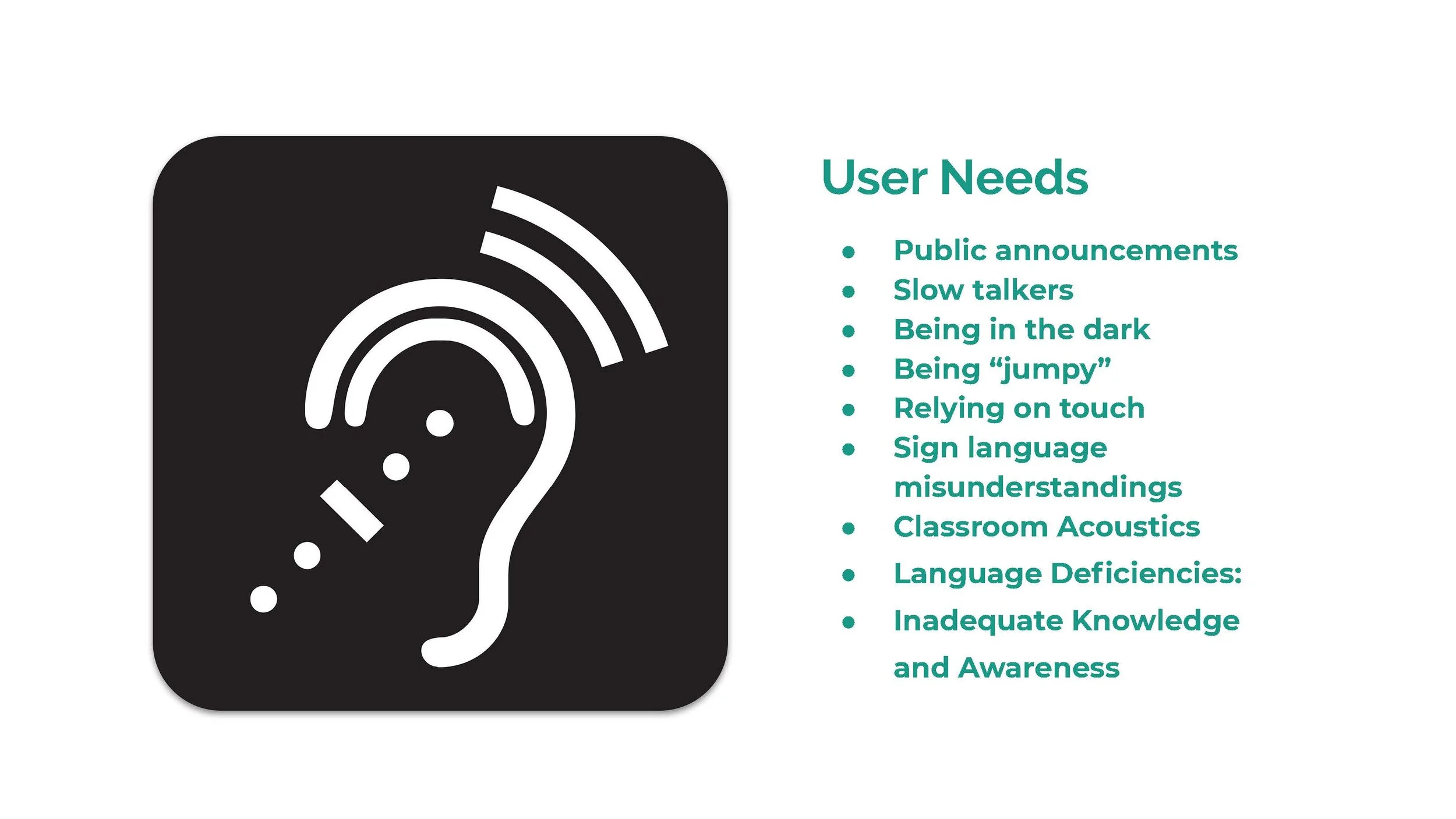
The initial phase of research focused on identifying areas of difficulty for hearing-impaired individuals. The following are the most significant problem areas in hearing accessibility.
PUBLIC ANNOUNCEMENTS
Although visual paging and prompting devices are becoming more common to accommodate hearing-impaired individuals, they remain relatively rare and restrictive, requiring users to watch them constantly. Because these devices are not widely available, users who rely on them cannot move freely without risking missed announcements.
LACK OF KNOWLEDGE AND
AWARENESS
Many individuals with hearing impairments have family members who struggle to communicate with them or to learn how best to support their needs. This is often due to a lack of accessible resources for both people with impairments and their families. Because hearing impairment is frequently marginalized, it can be difficult for these individuals to communicate with others in daily life, since hearing-accessibility practices are not widely taught to the general population.
HEARING DIFFICULTIES FOR
STUDENTS
Classrooms are often challenging for hearing-impaired students. In their current layouts, classroom acoustics frequently do not carry in ways that benefit these students. Studies show hearing-impaired students hear best in a classroom arranged in a horseshoe configuration. Additionally, lighting is crucial for learning and hearing accessibility because it enhances sign-language visibility and lipreading.
LANGUAGE DEFICIENCIES
Hearing accommodations often serve only a small portion of the hearing-impaired community, overlooking the diverse and varied needs of this group. A common shortcoming is language accessibility: many visual accommodations provide translations in only one language, typically English.
We found that many intersectional user needs—communication, navigation, and audio announcements—are not properly addressed by current airport systems. Further research uncovered numerous accounts of frustration and embarrassment as travelers encountered untrained staff and inadequate accommodations. Users reported frustration with a tedious accommodation-request system that usually requires advance notice and often results in overly general or unnecessary provisions (for example, wheelchairs). They also described confusion and stress during security screening, where staff’s lack of awareness about communication needs led to uncertainty about how to proceed and how to handle hearing aids.
PROTO PERSONAS
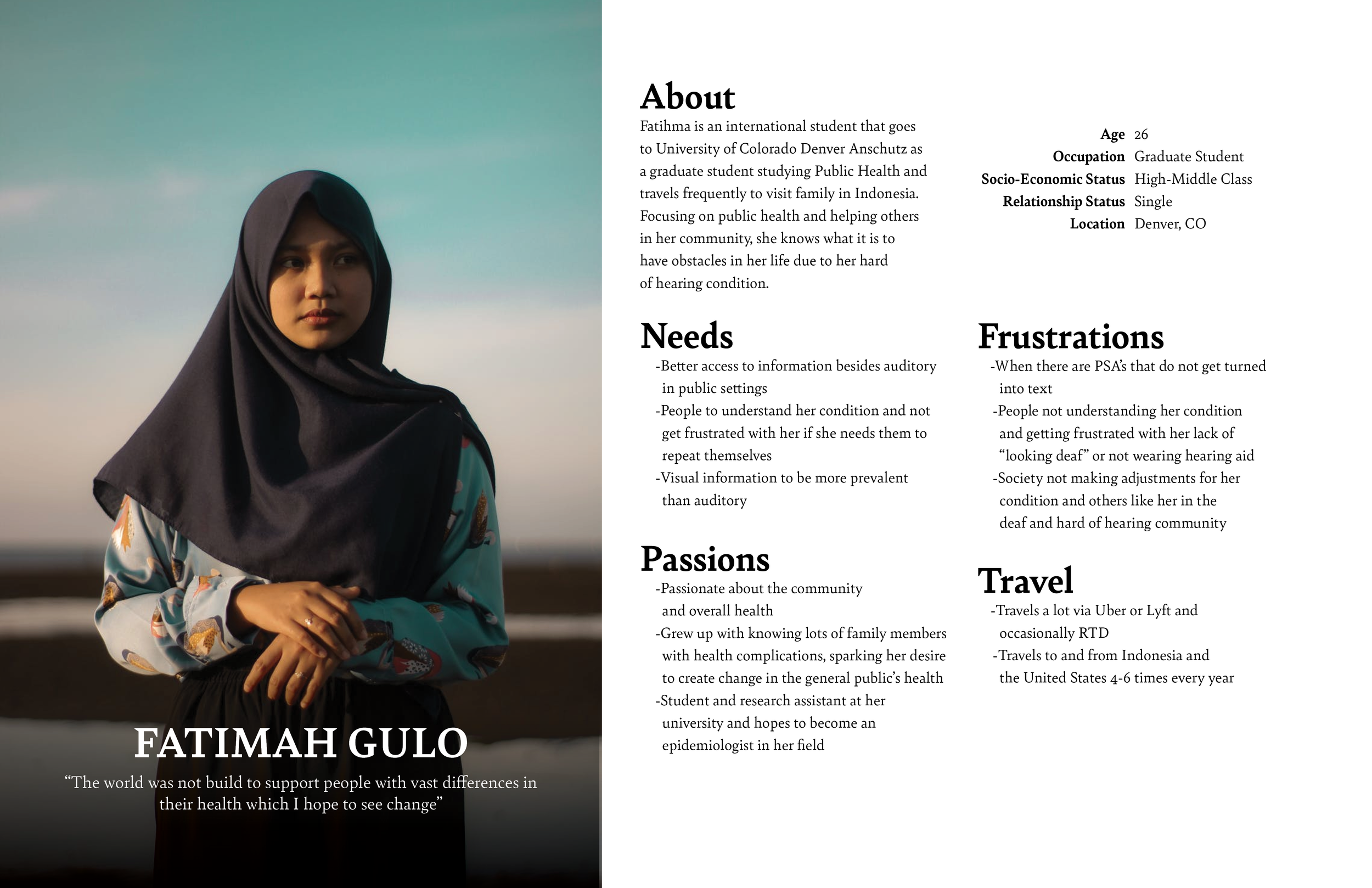
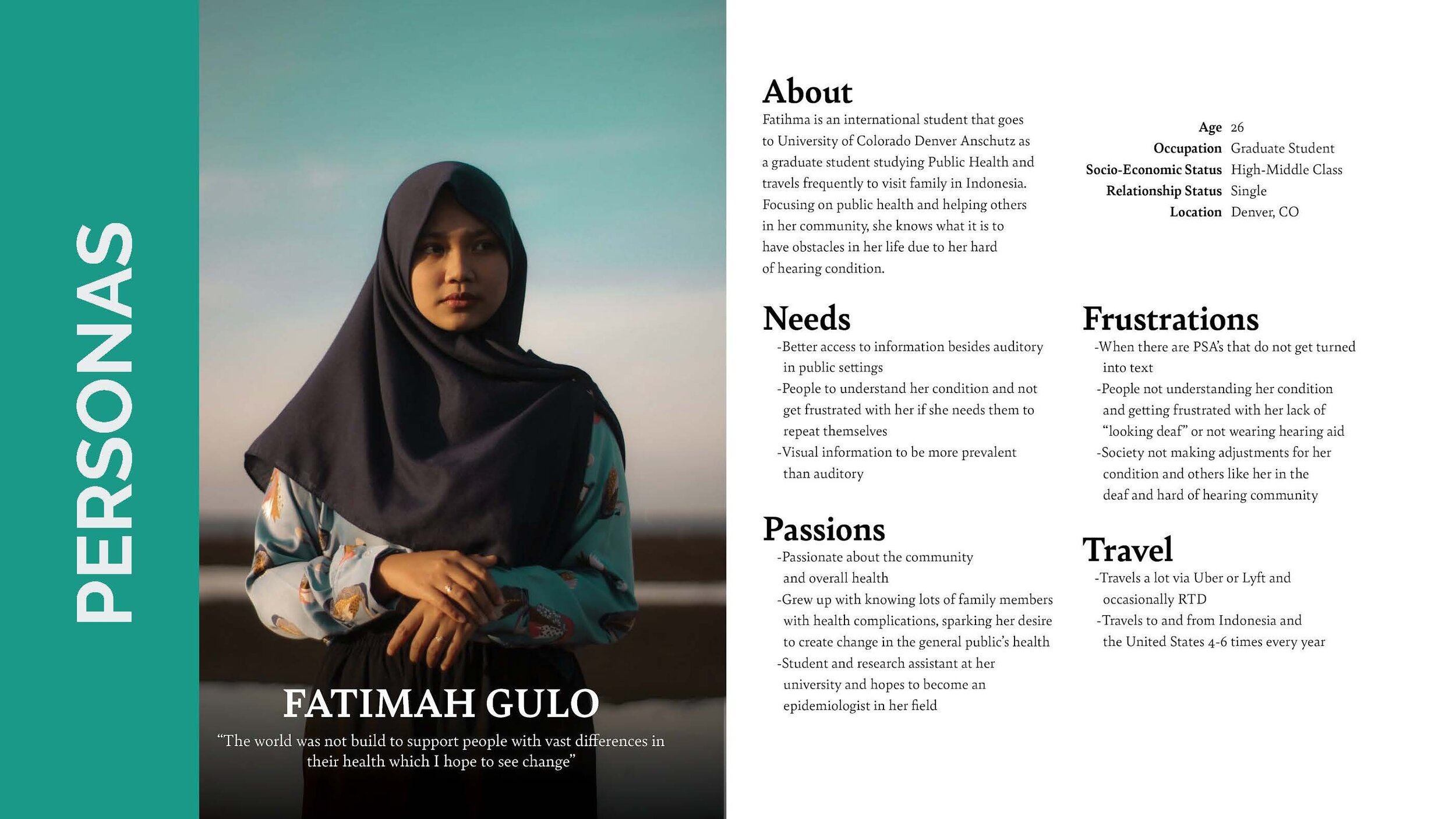
From our initial user research, we developed two user personas representing groups often neglected by common hearing-accommodation systems. Fatimah Guloh represents people who, in addition to having hearing impairments, face cultural adjustment challenges and stress related to airport treatment of people of color. Her priority is minimizing stress during security screening and increasing preparedness to avoid confusion.
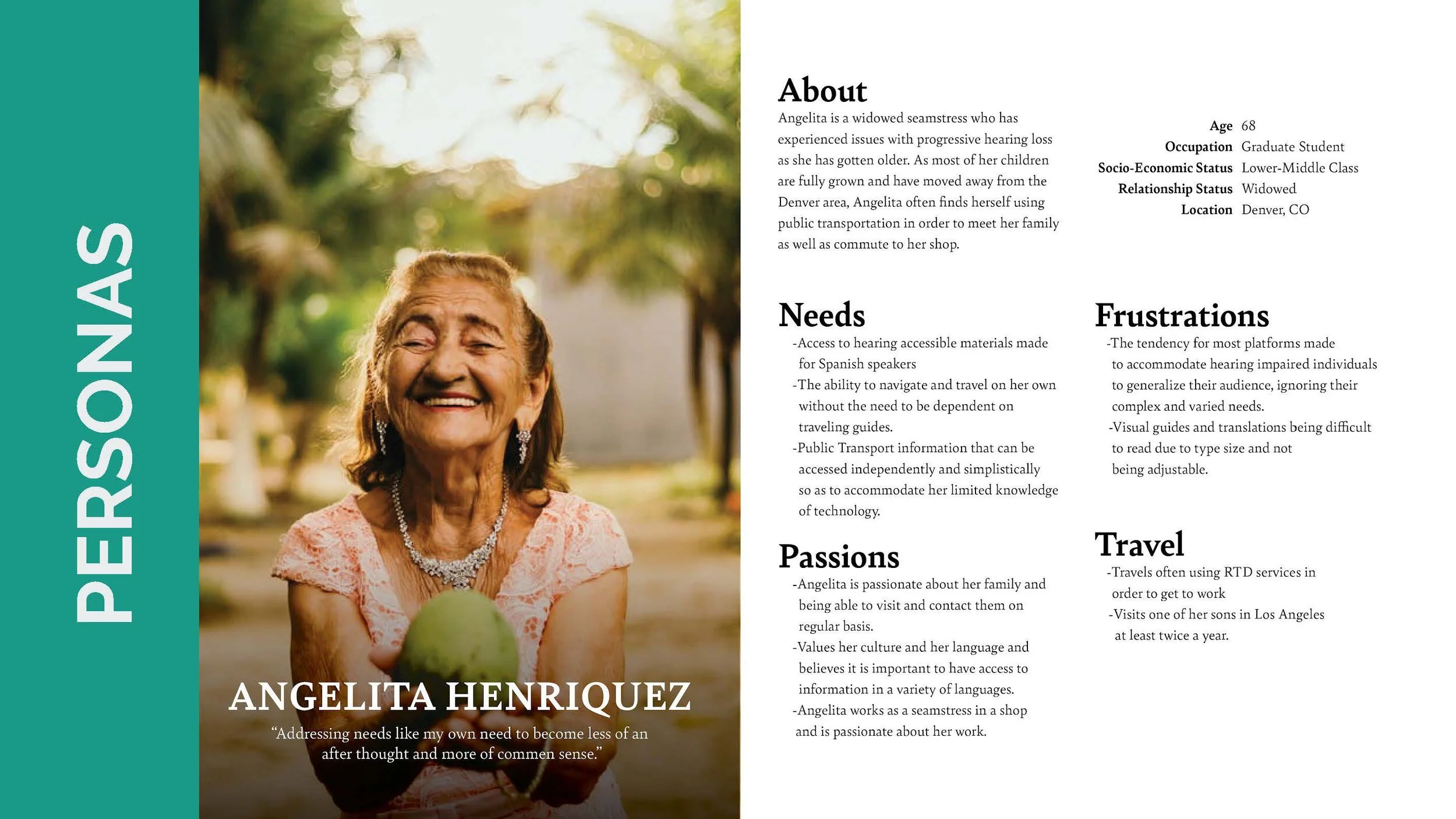
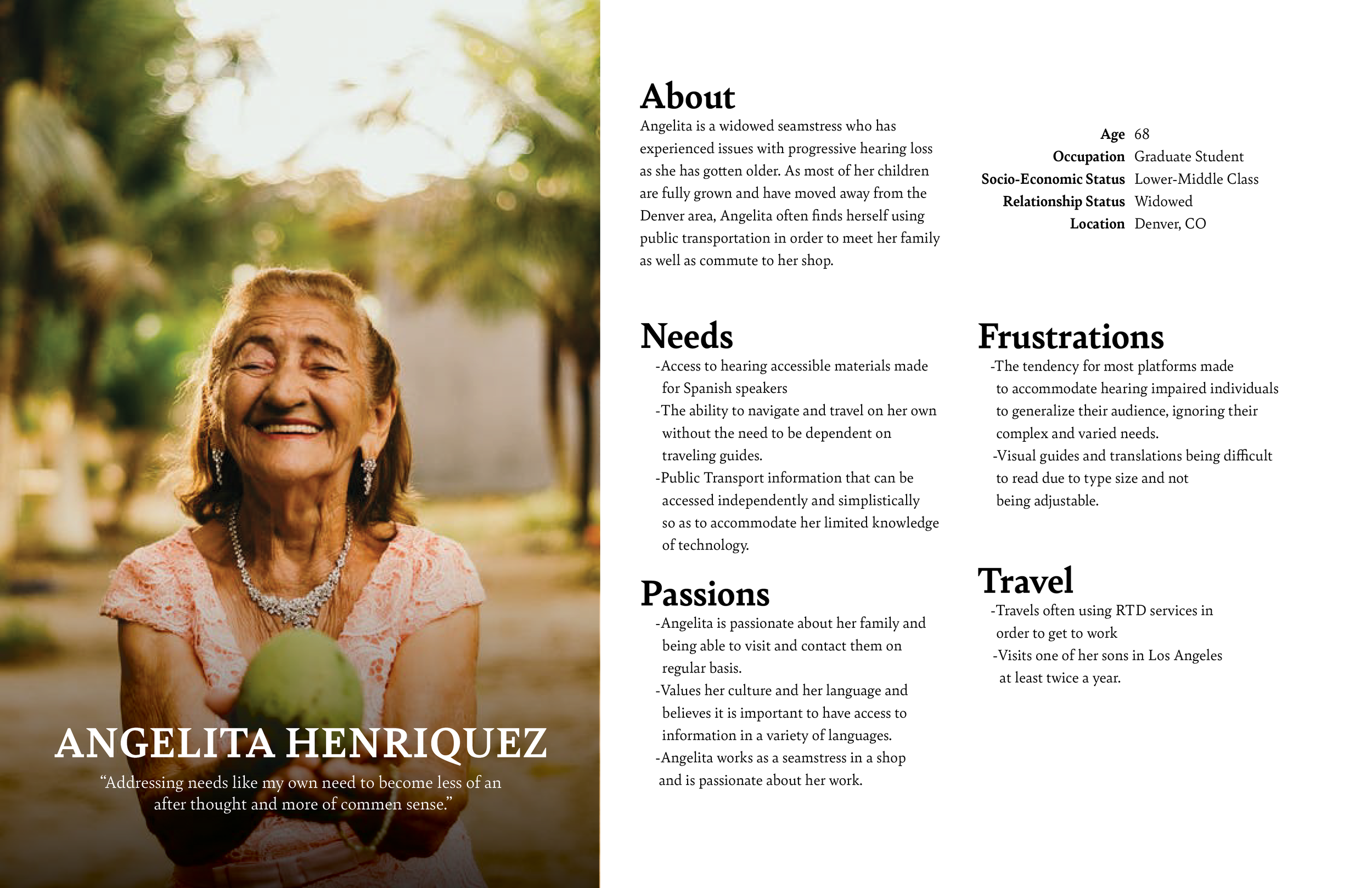
Angelita Henriquez represents an older population who, besides hearing difficulties, may require language accommodations to understand important information in her native language. She values independence and wants to navigate travel as autonomously as other travelers.
EXISTING TECHNOLOGIES AND CURRENT SOLUTIONS
GEO FENCE
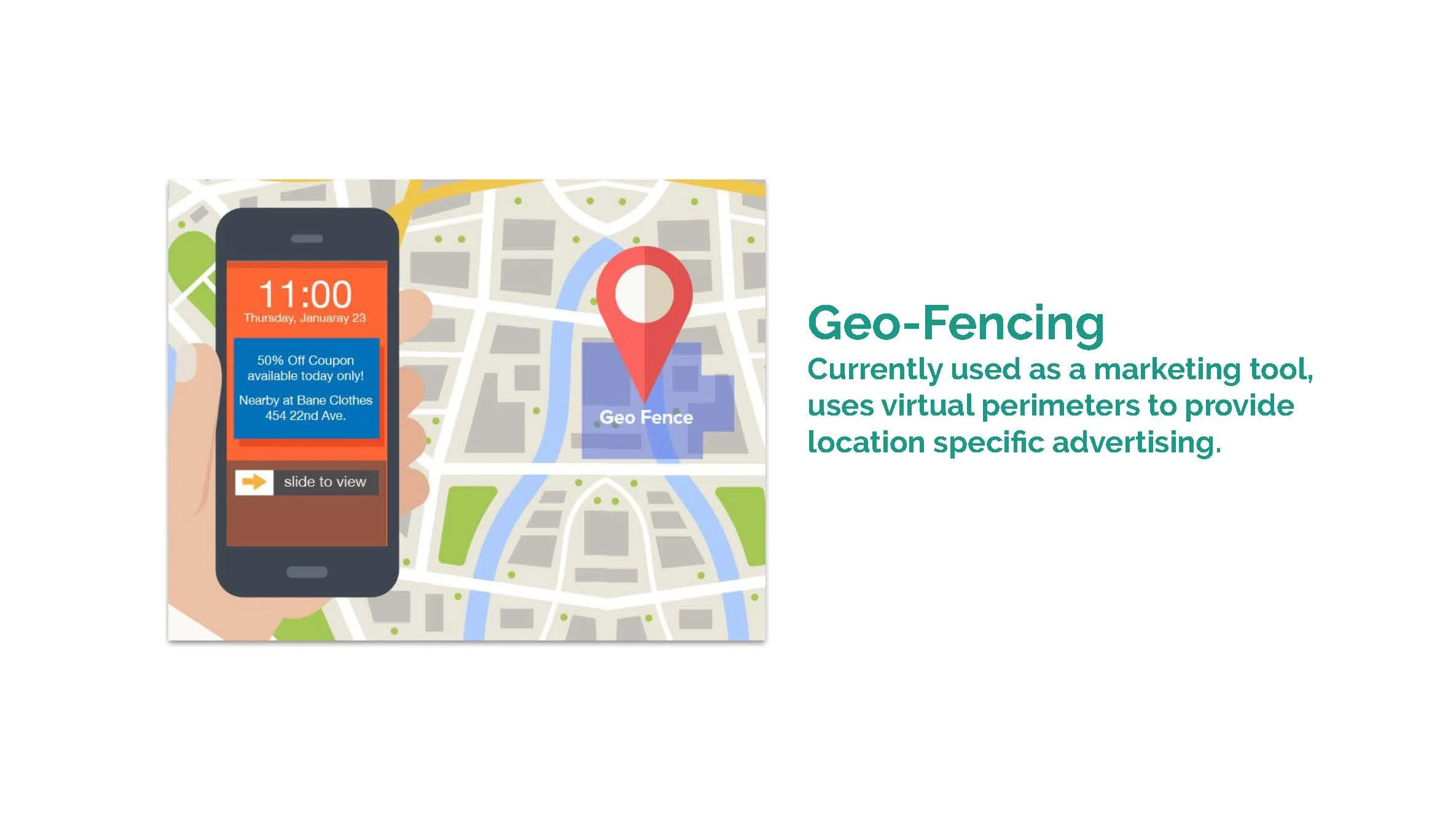
Many emerging technologies aim to improve experiences for people with hearing impairments, such as visual prompters that display typically audio-only announcements. Airports are noisy environments with multiple, simultaneous announcements, any of which could be important. Travelers also move throughout the facility, and announcement content can vary by location.
Geo-fencing, typically used for marketing, could be adapted for location-specific announcement systems to prevent users from being overwhelmed by facility-wide broadcasts. The technology creates virtual perimeters around areas so content tied to a specific gate or terminal is delivered only to people within that perimeter, using geo-positioning methods.
ADA HEARING LAWS
The Americans with Disabilities Act (ADA) requires airports to offer accessible communication options—such as auxiliary hearing aids and visual broadcasts—typically upon request. Although progress has been made, these services are often limited in scope, offered in few languages, and frequently require significant effort from travelers before their trip.
Under the ADA, many airports provide visual prompters for boarding announcements, but these are usually restricted to certain languages and require passengers to remain in one place to avoid missing calls. Because wait times and layovers can be long and tedious, relying on a single visual display is inconvenient and can cause travelers to miss important information.
USER JOURNEY MAP
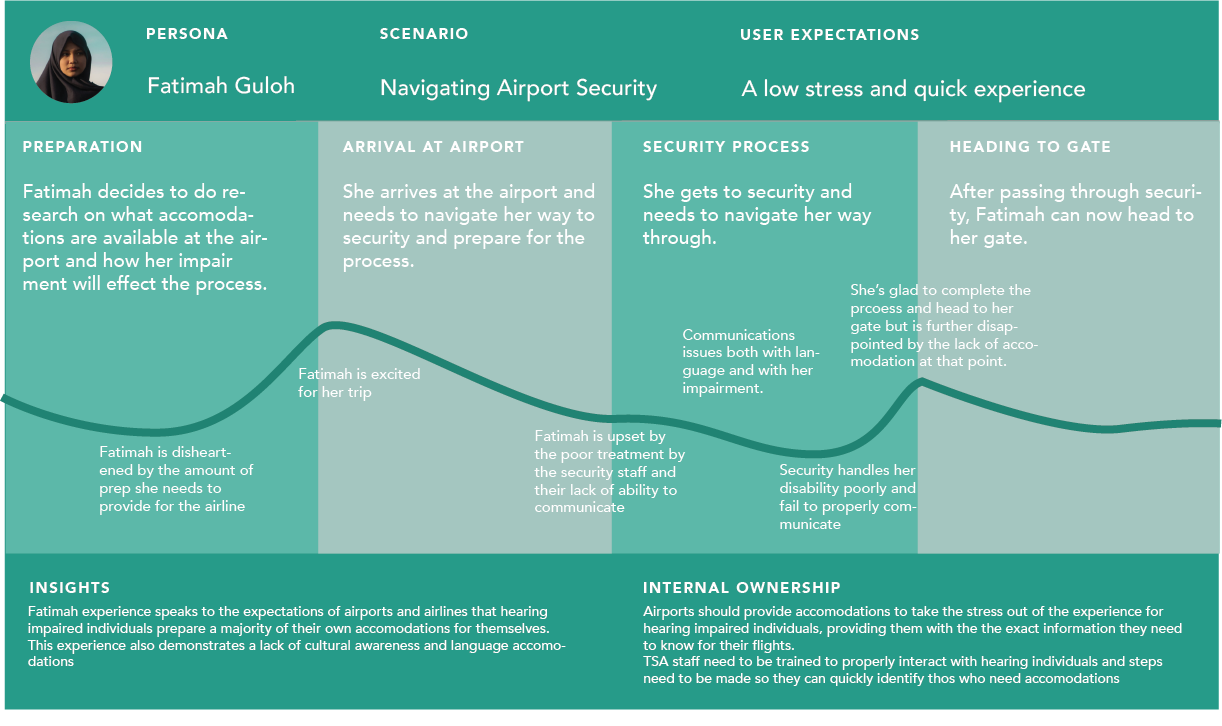
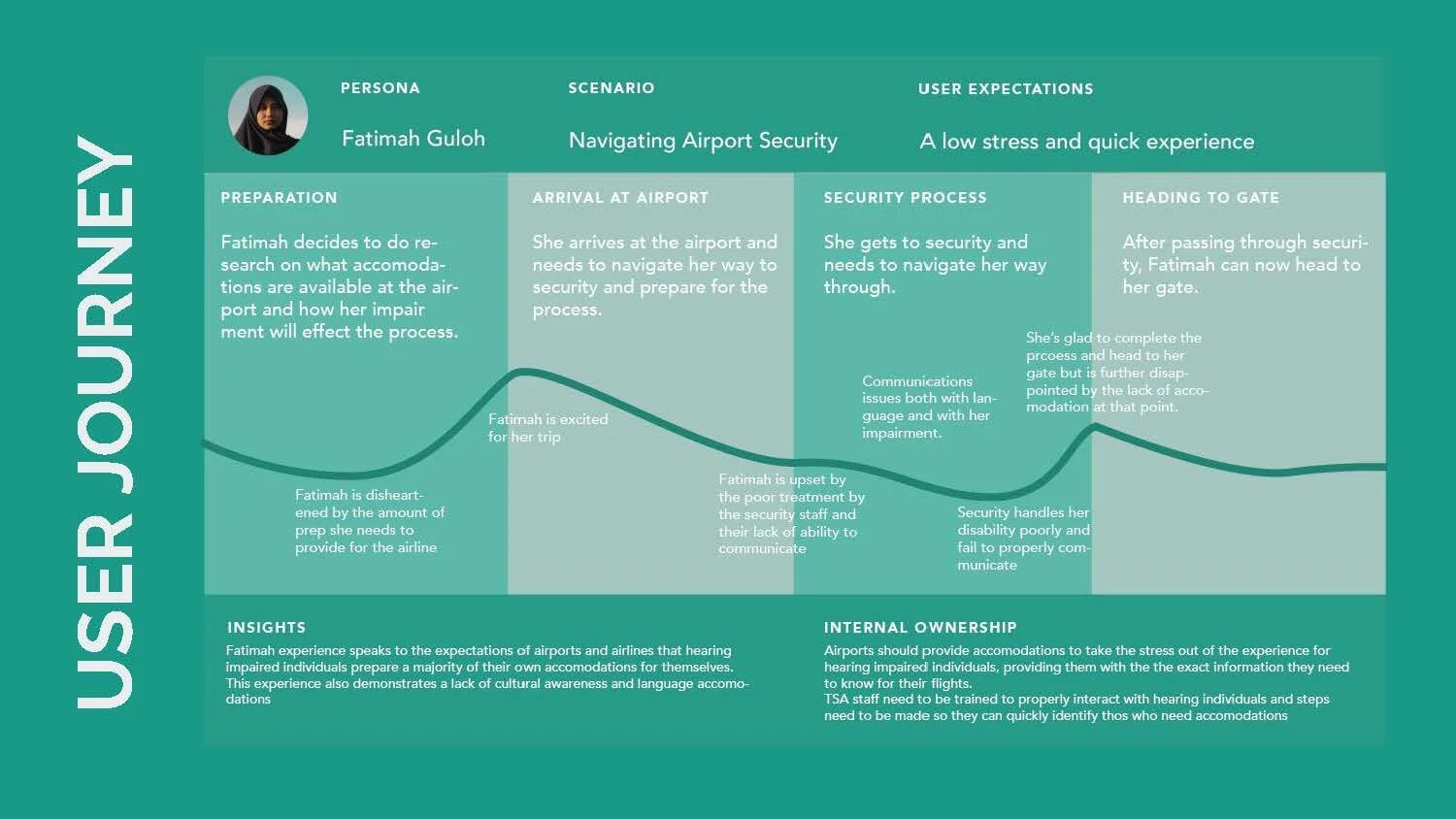
Fatimah User Journey Map
In order to better understand the way the experiences, desires, and goals of our users, we drafted a user journey map in order to find actionable areas of improvement for airport systems. The user journey map above analyzes the experience of our persona, Fatimah Guloh, as she navigates a TSA checkpoint with her hearing impairment. Our map highlighted difficulties with communication and understanding as Fatimah navigated this part of her trip, citing the staff’s lack of awareness as to how to interact and communicate with her, adding to the stress she experienced in that environment.
CONCEPTING AND DESIGN PROCESS
THE CONCEPT
From our research, we concluded that a system of primarily printed information materials emphasizing communication and preparedness during airport travel would best address our users needs. We decided to veer in the direction of printed analog materials as in highly stressful and tense areas such as airports, awareness of surroundings is imperative so as to avoid any
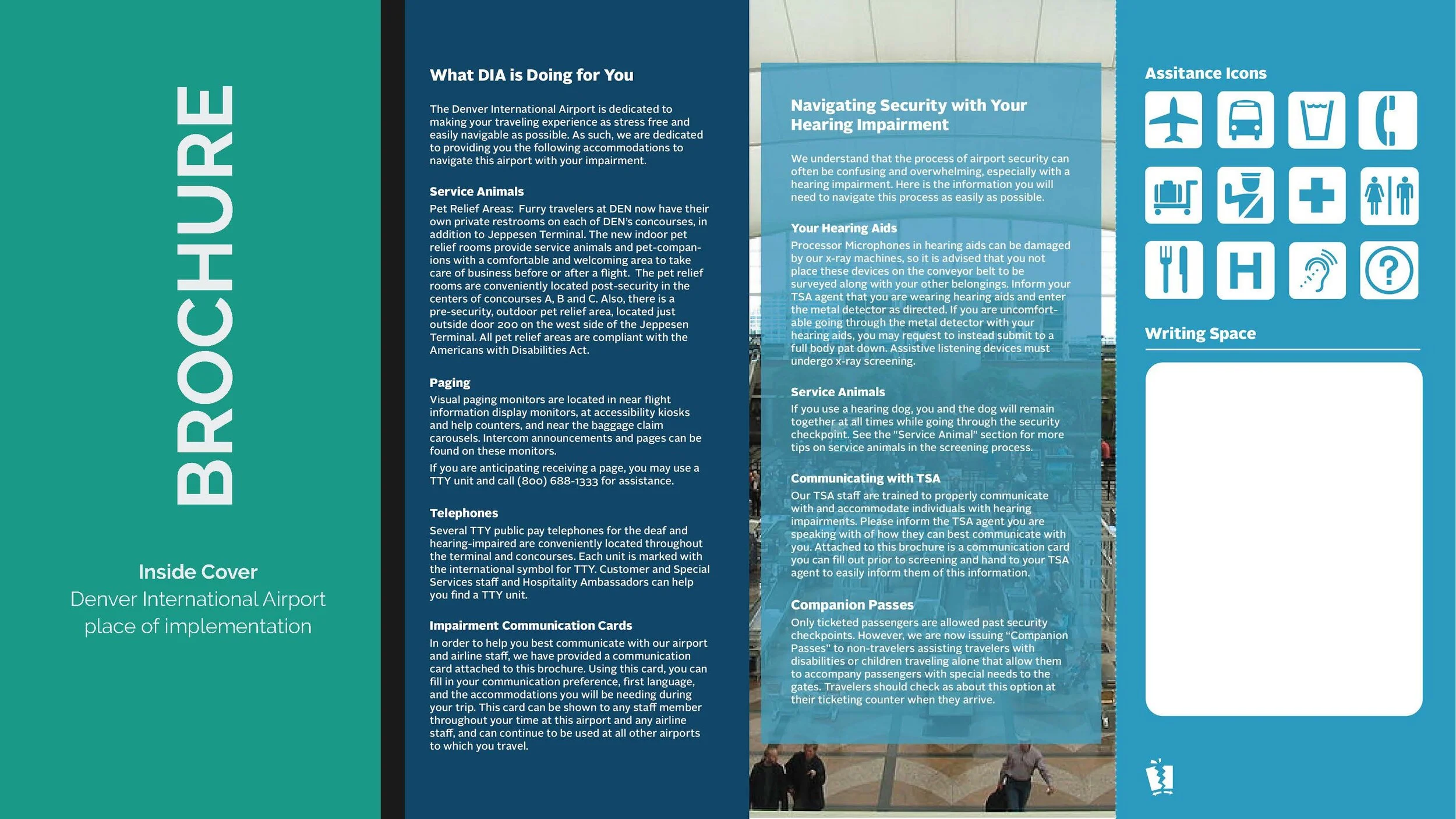
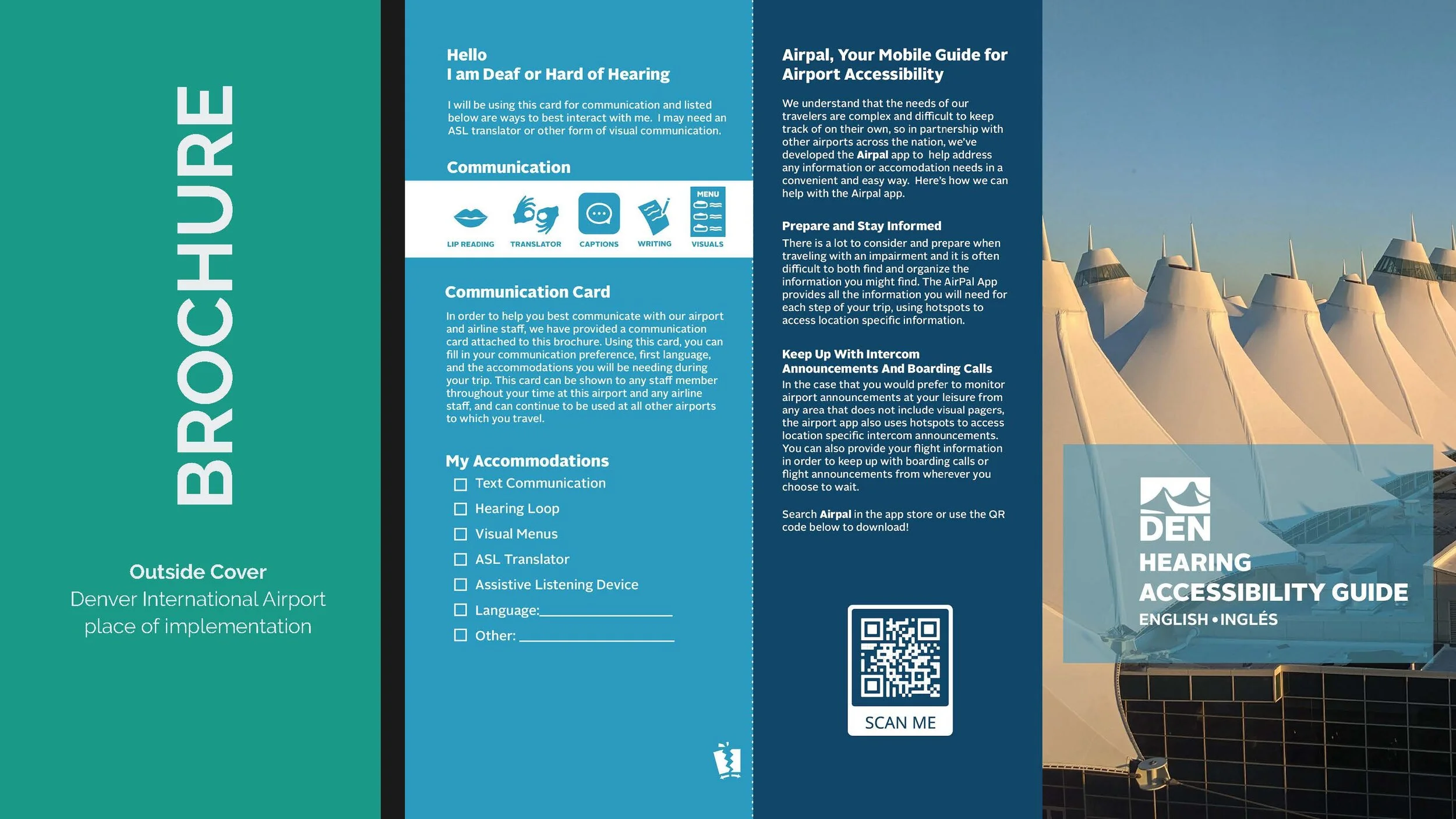
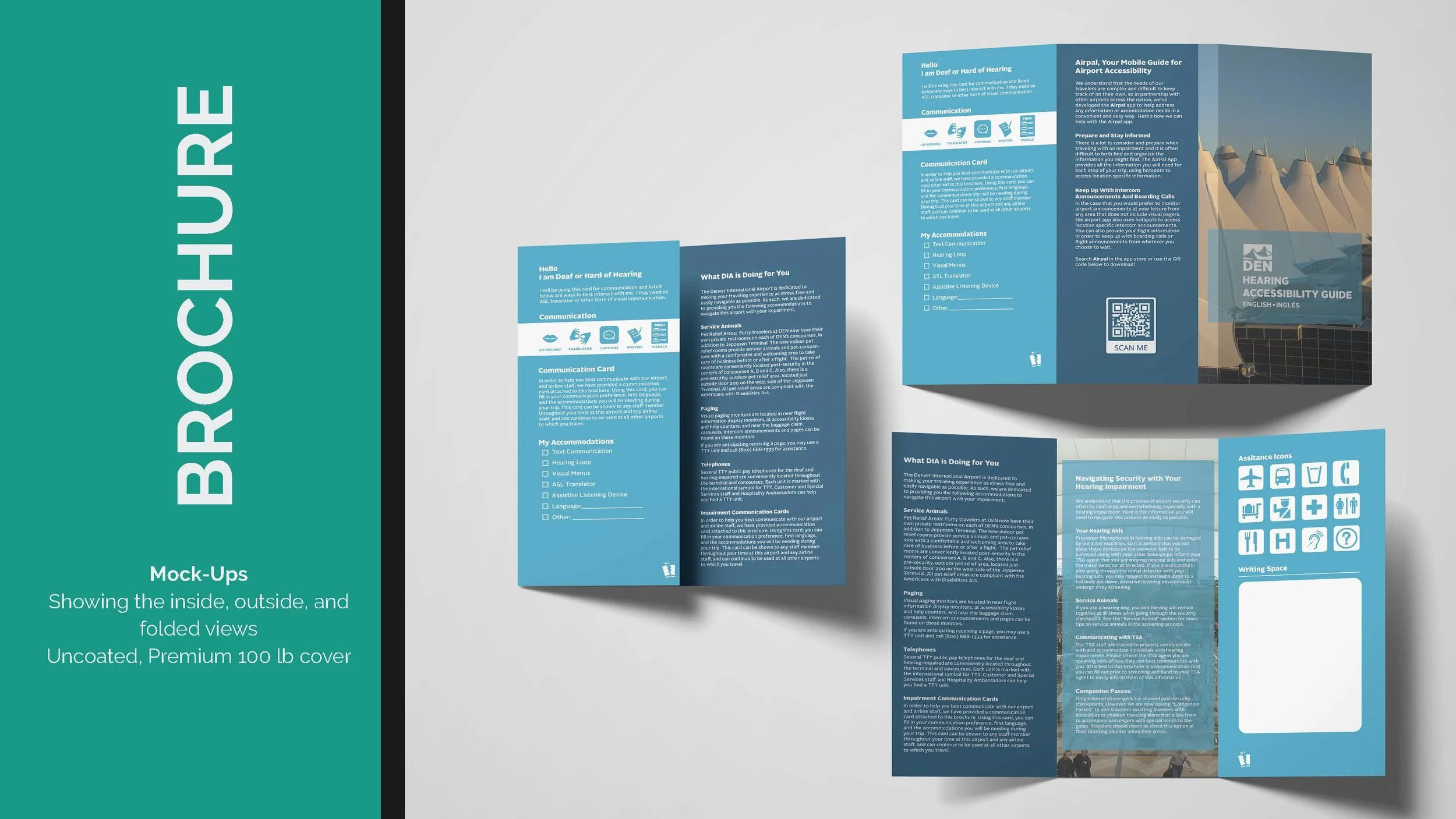
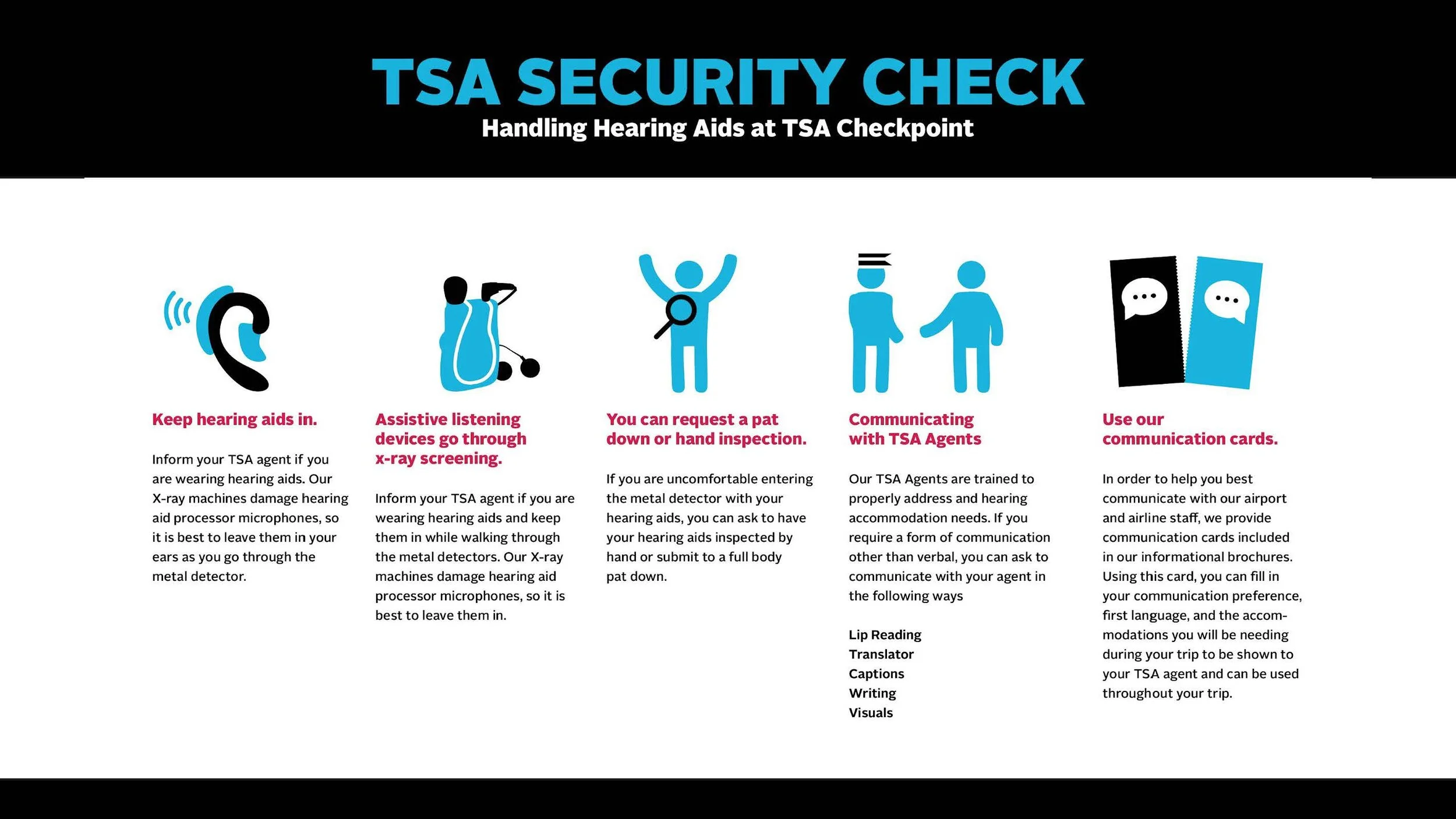
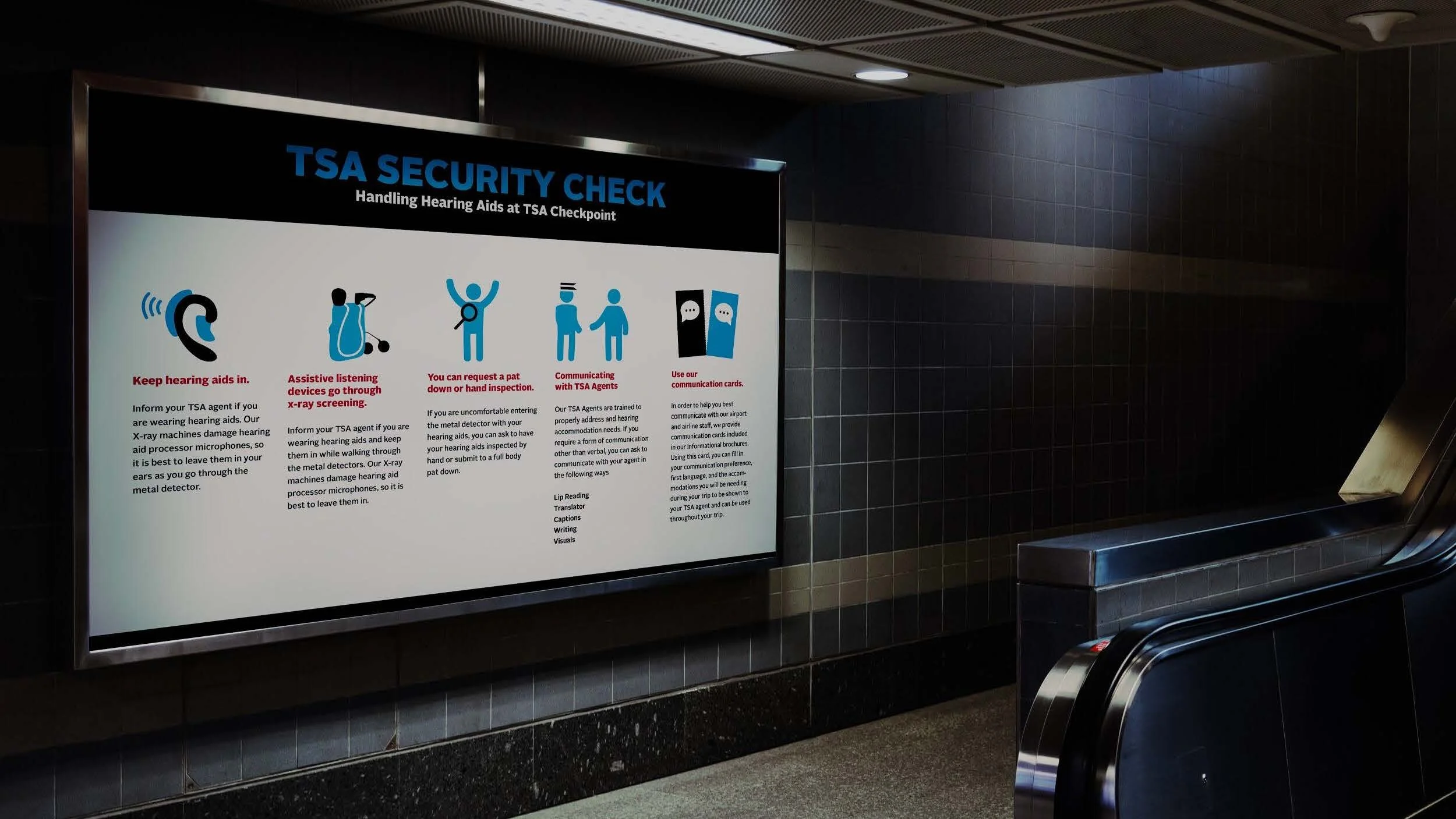
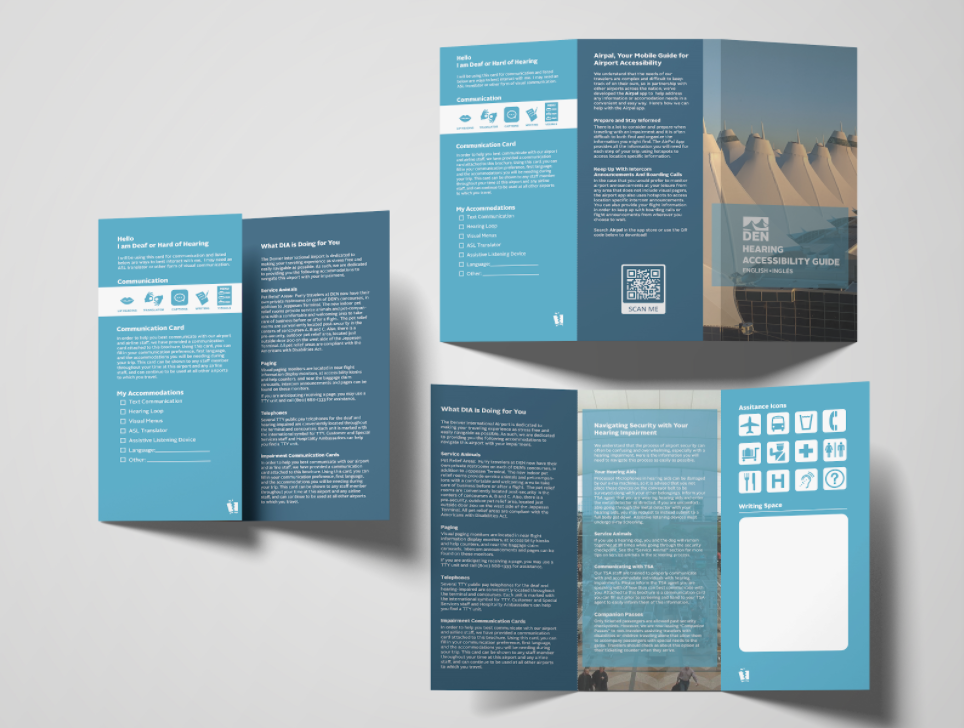
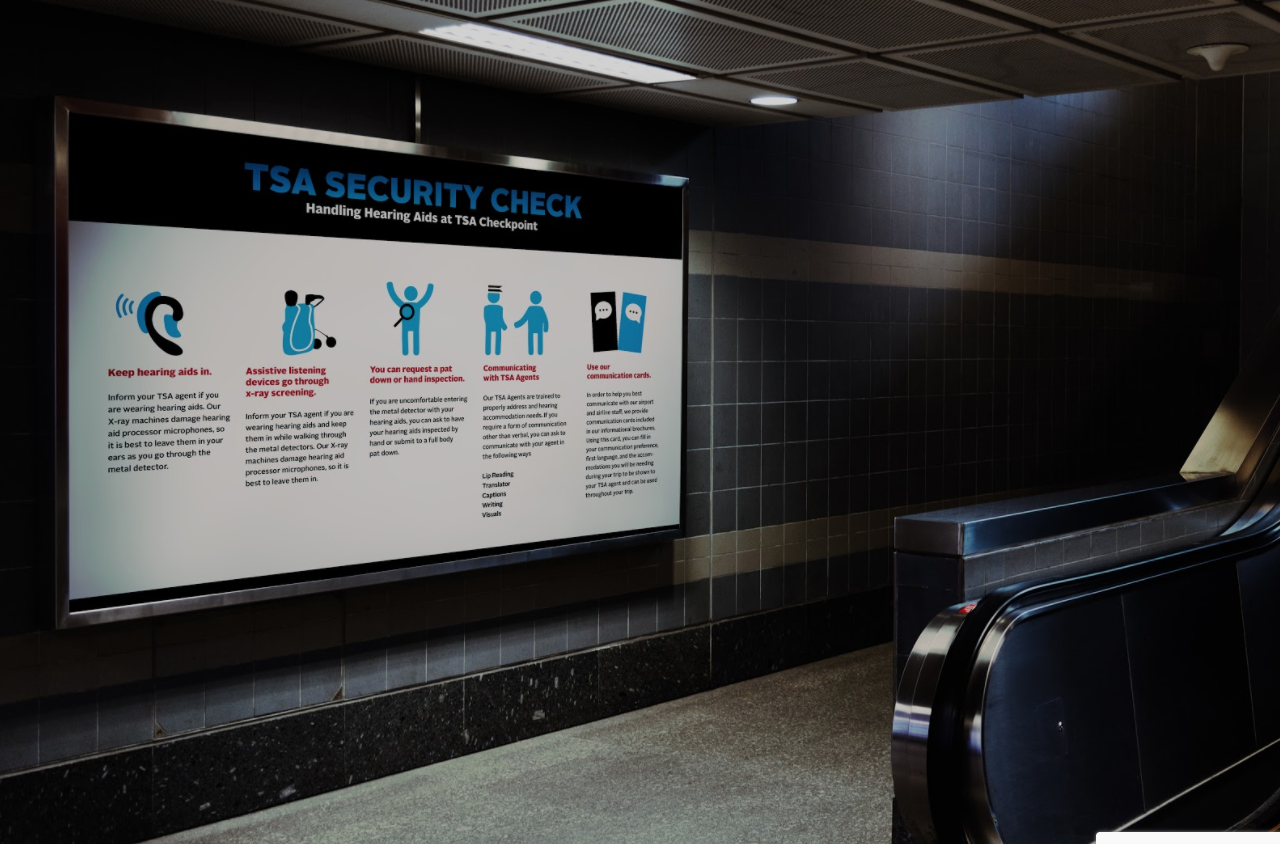
misunderstanding or miscommunications. Printed materials are tangible, easy to carry around, and easy for all populations to interact with. This system would include informative infographics for hearing impaired travels going through TSA checkpoints, informing them of how to communicate with agents and how to handle their hearing devices, brochures with additional information on airport accommodations, and an info card that travelers could care to visually communicate their needs to airport staff throughout the facility.
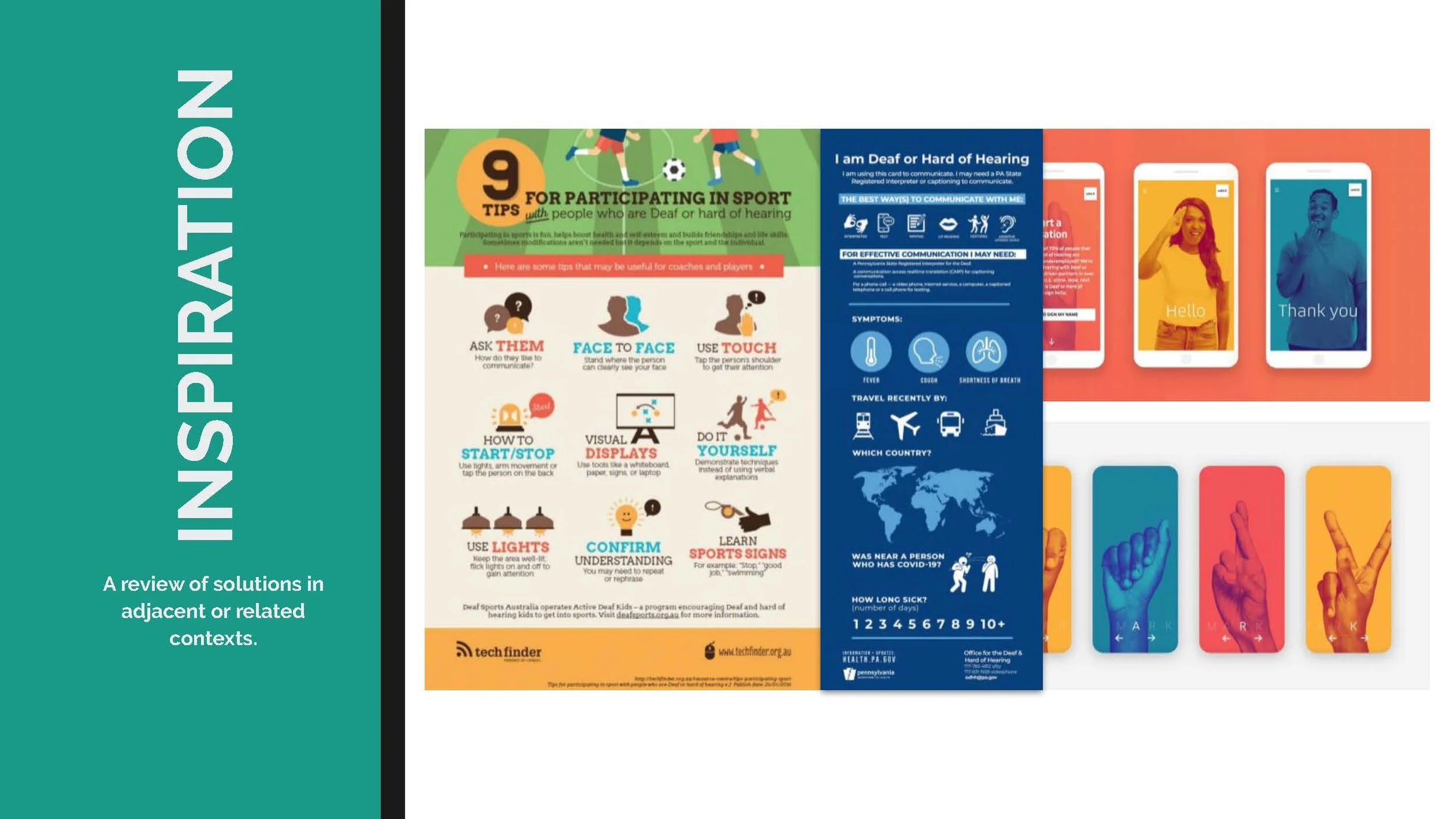
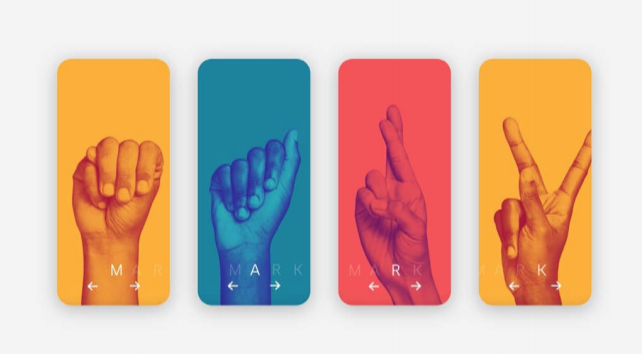
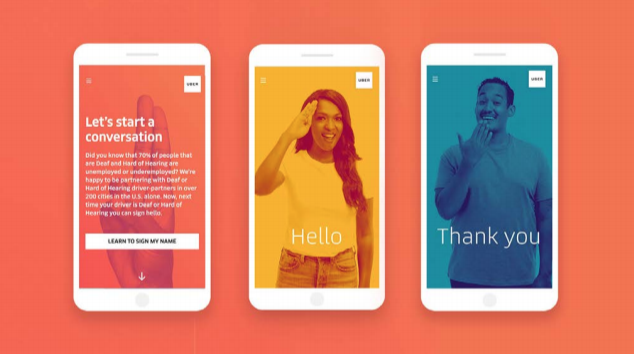
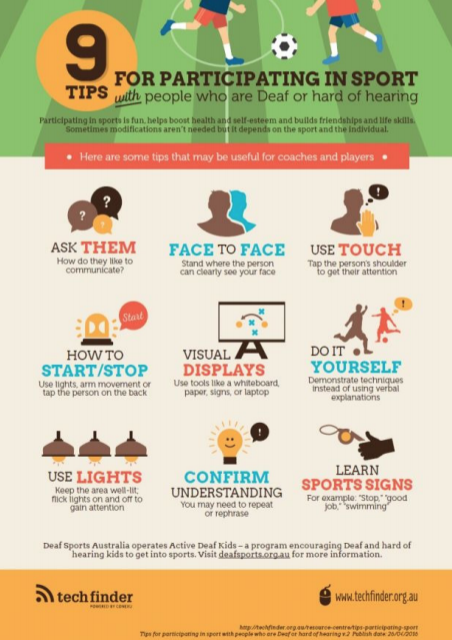
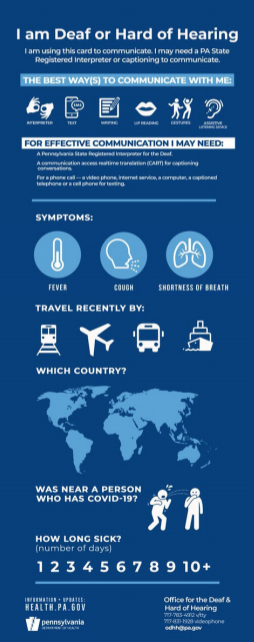
In developing our visual solution, we looked to current print designs made to cater to hearing impaired populations so as to best understand baseline features and expectations for our final solution. The gallery above shows solutions we viewed and looked to for inspiration as to how to formulate our designs.
SKETCHES
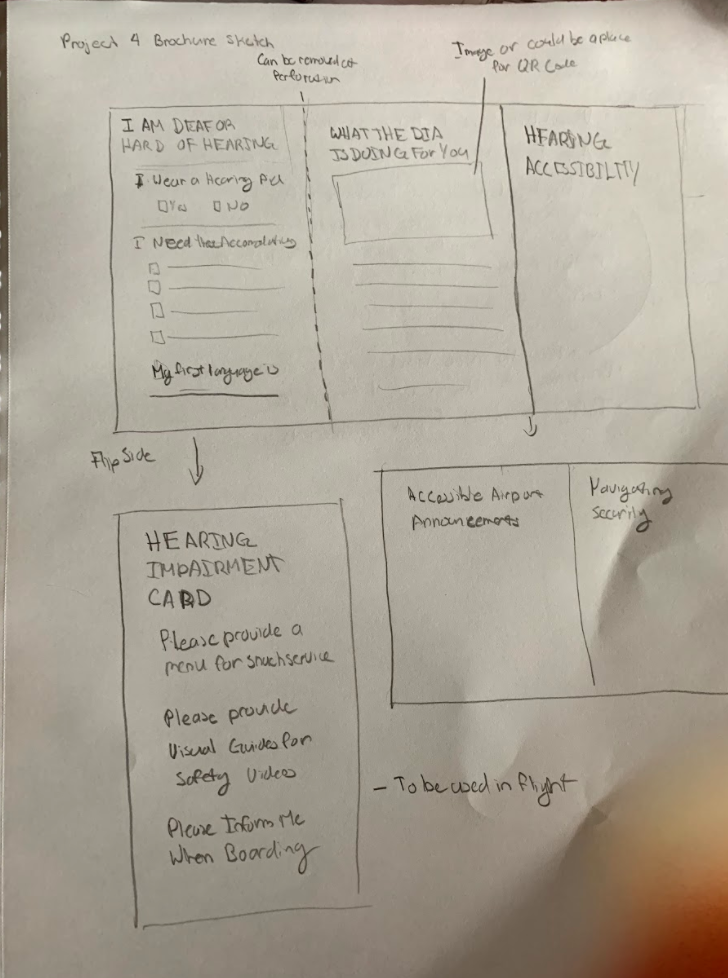
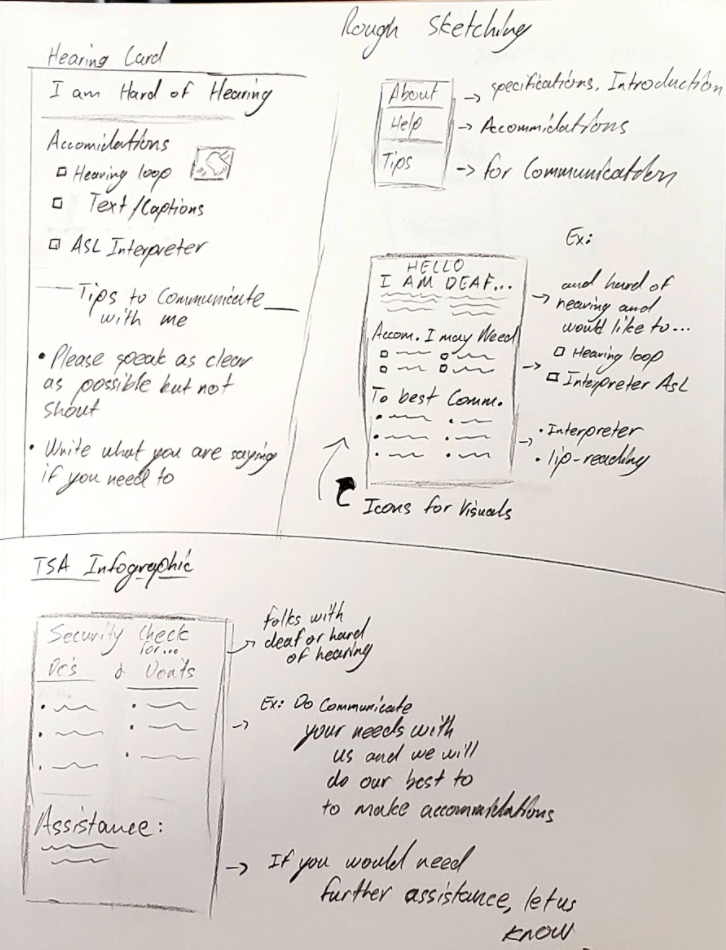
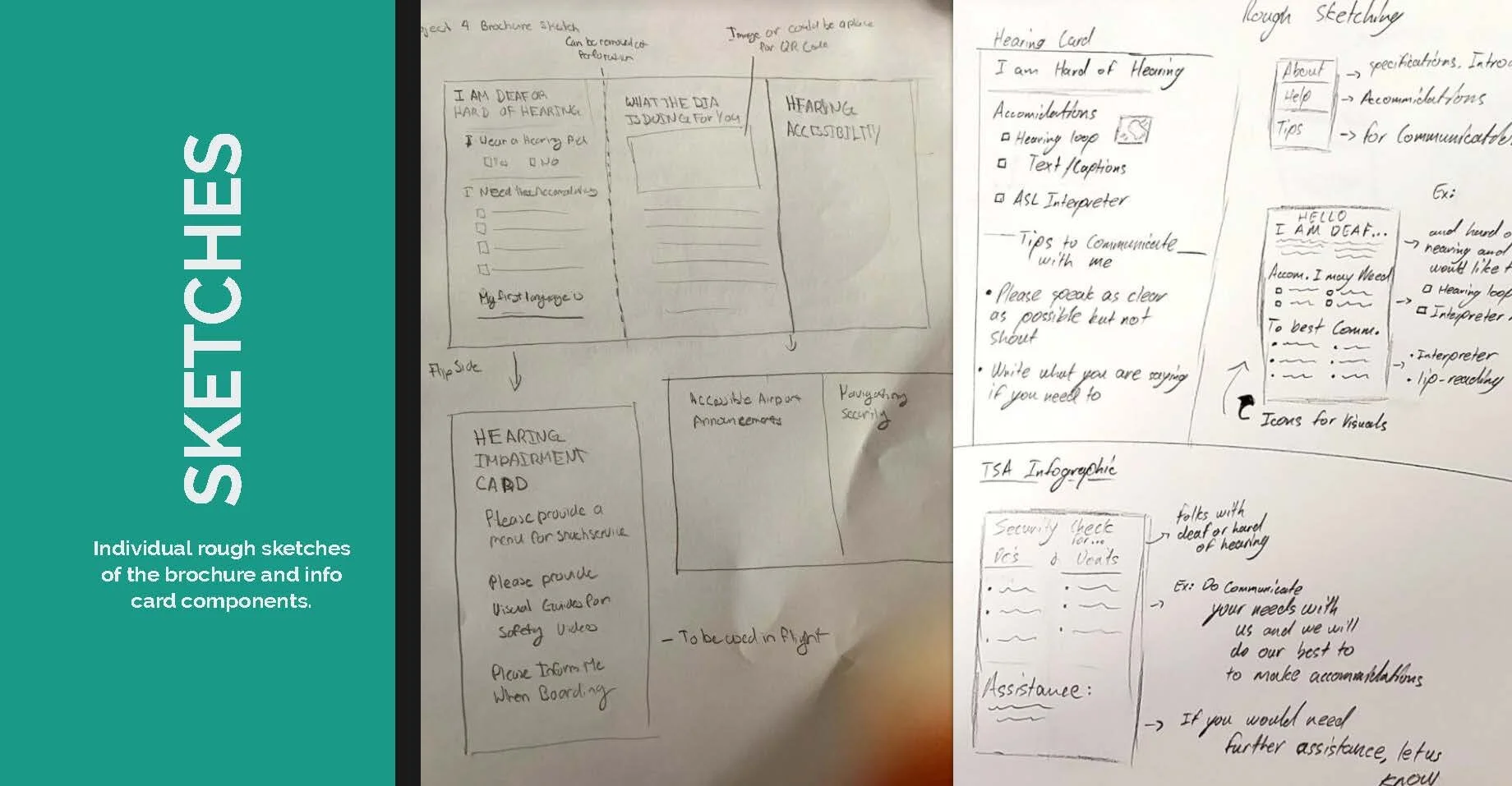
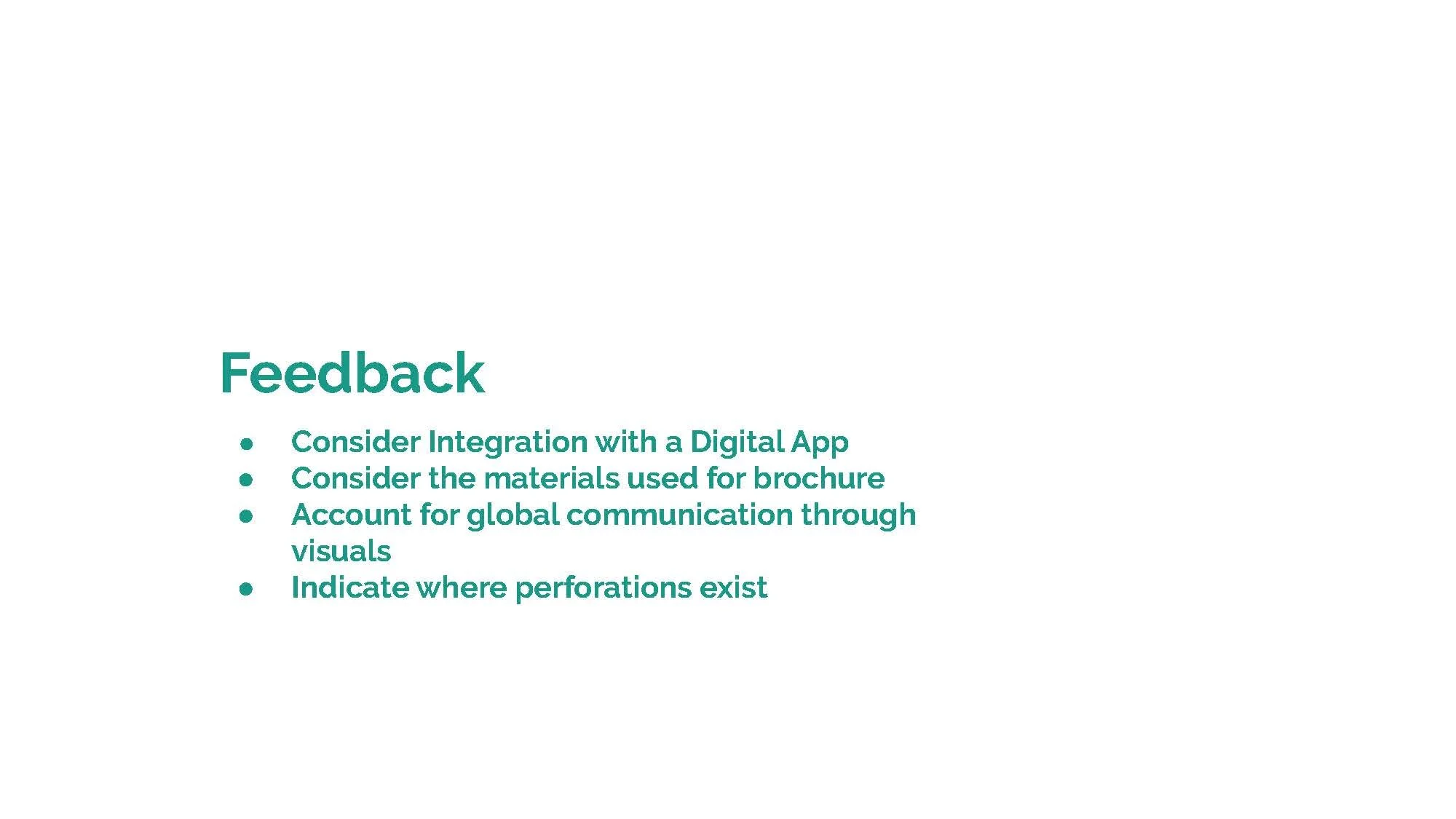
Individually, we formulated rough sketches so as have a variety of features we could pick and choose from. Our initial sketches focussed on the layout of our brochure materials and infographics as well as an initial exploration of content to be included in the design.We then reviewed our initial planning and concept in small feedback groups in order gain insights into what could be improved and what content seemed important to add to our finals design. Through these sessions, we concluded that while individuals responded positively to our system of print materials, many suggested to consider to relevance of digital material in the current social climate and to consider the integration of a digital information system with a system of print materials.
THE SYSTEM
The result of our research and iterative process is an integrated information system combining print and digital components. Users receive accessible print materials and environmental graphics to help navigate the airport, and are encouraged to download an app that digitizes the same content and delivers visualized, location-specific announcements so they can stay informed while freely moving around the terminal during long delays.
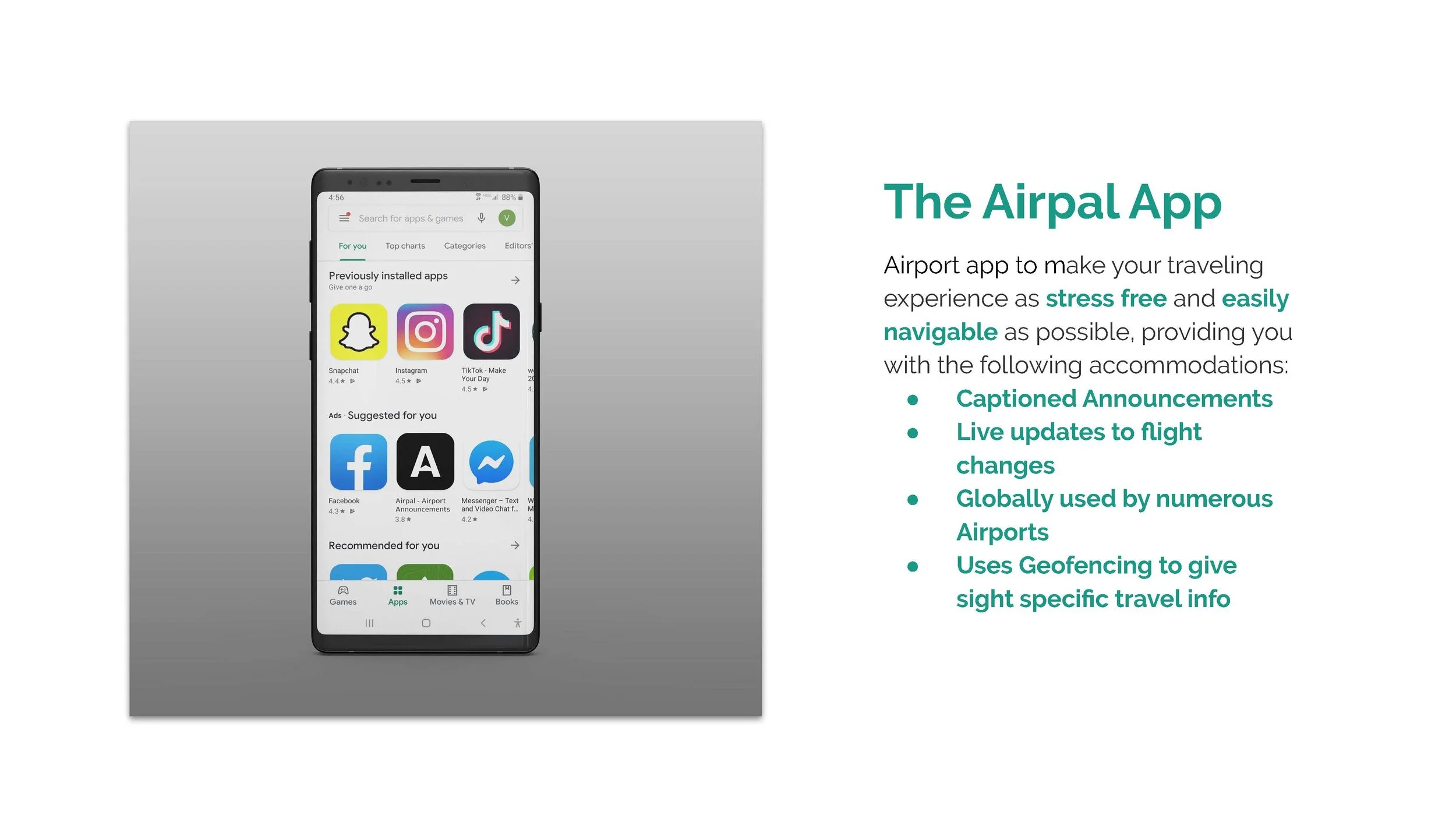
AIRPAL
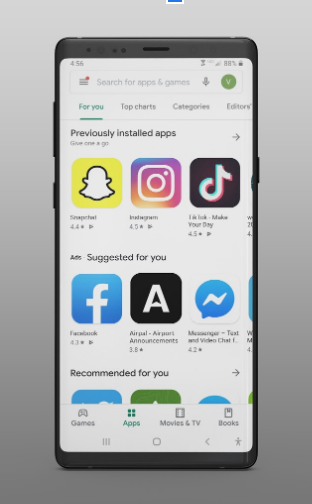
The Airpal app is designed to make your travel experience as stress-free and easy to navigate as possible. Like the printed materials, Airpal is informative and convenient, reducing airport-related stress. To integrate the two systems, brochures and environmental graphics throughout the airport include QR codes to promote the service and provide quick access. The Airpal app provides the following accommodations:
Captioned Announcements with a large variety of language options.
Live updates to flight changes.
Organized information on available airport and flight accommodations.
Globally used by numerous Airports.
Uses Geofencing to give sight specific travel info.
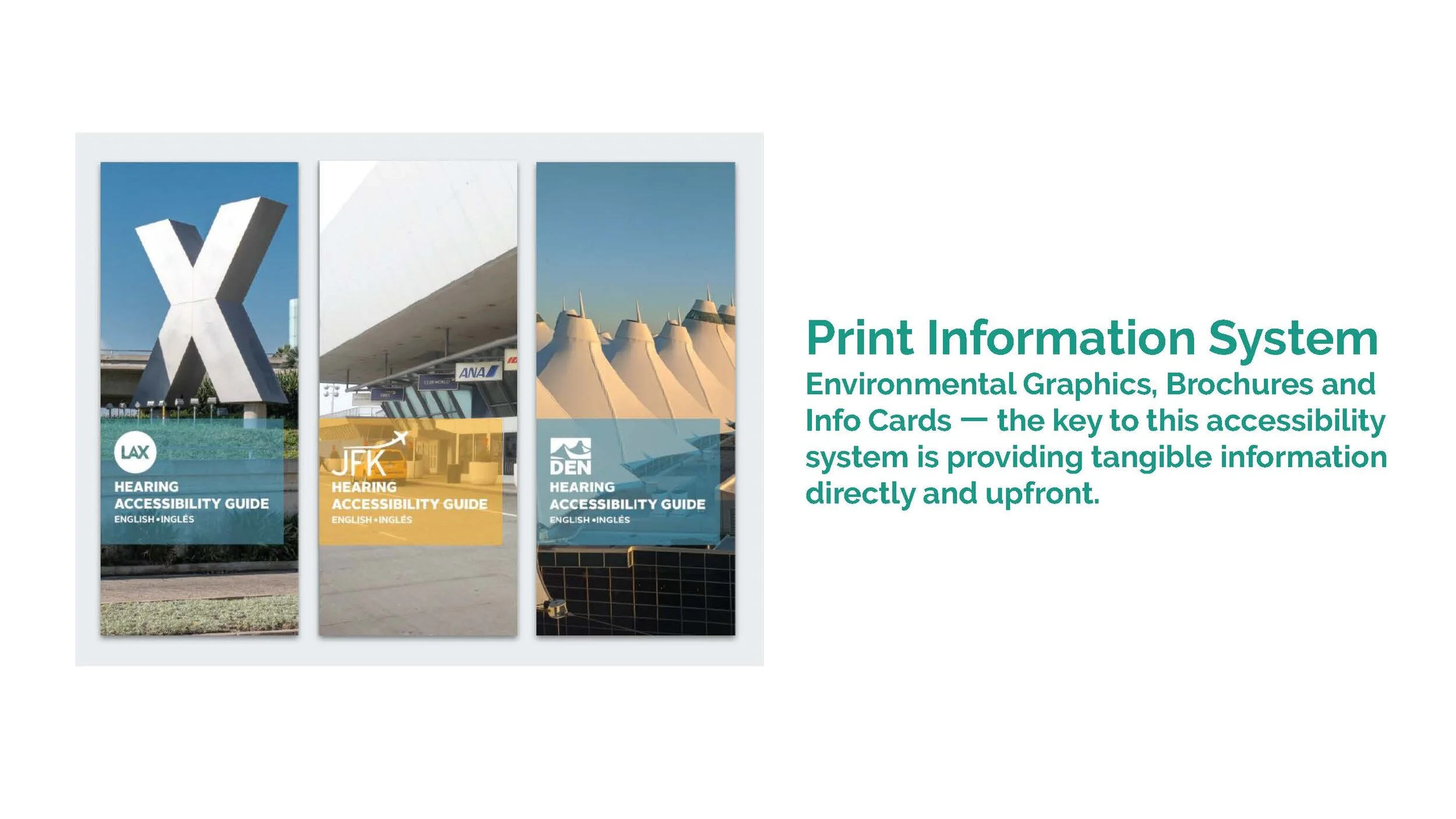
PRINTED INFORMATION SYSTEM
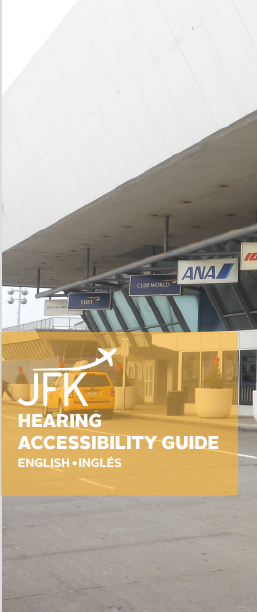
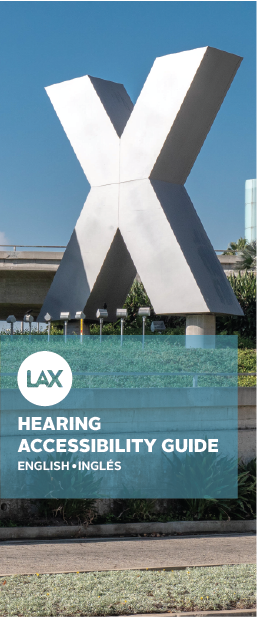
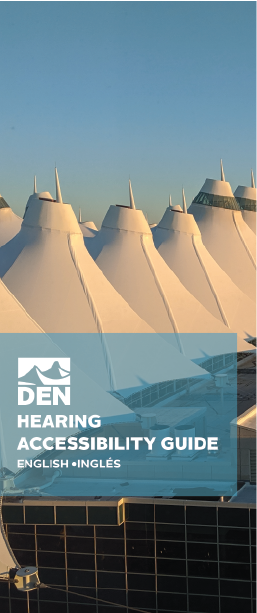
Environmental graphics, brochures, and info cards — the core of this accessibility system — provide tangible information upfront. As shown in the gallery above, the print system can be deployed in airports globally to support seamless communication. Its goals are to encourage awareness, preparedness, and clear communication throughout the airport experience to prevent misunderstandings. The brochure contains essential information on airport accommodations to promote facility accountability, guidance for navigating TSA, and an attached info card travelers can show staff to improve communication.
DESIGN IN CONTEXT
RETROSPECTIVE
KEY CHALLENGES
It was important to my team not to assume this user group's needs, so we relied on research using reliable sources and firsthand accounts. Conducting that research was difficult because the project took place during the pandemic, which limited access to people and resources. As a result, we expanded our literature review and collected as many user accounts as possible to compensate for the insights we could not obtain through in-person interviews.
KEY INSIGHTS
Although accessibility has guided many of my design decisions, I have not yet fully addressed its complexity or the intersecting nature of user needs. Accessibility is often treated as one-sided; as a student, I was trained to address individual needs separately rather than as interacting system requirements. This project highlighted hearing-impaired users from a multicultural perspective and showed how the airport experience is not equal for everyone. It forced me to consider not only hearing accommodations but also how those accommodations are affected by culture, language, and social position.